Introduction
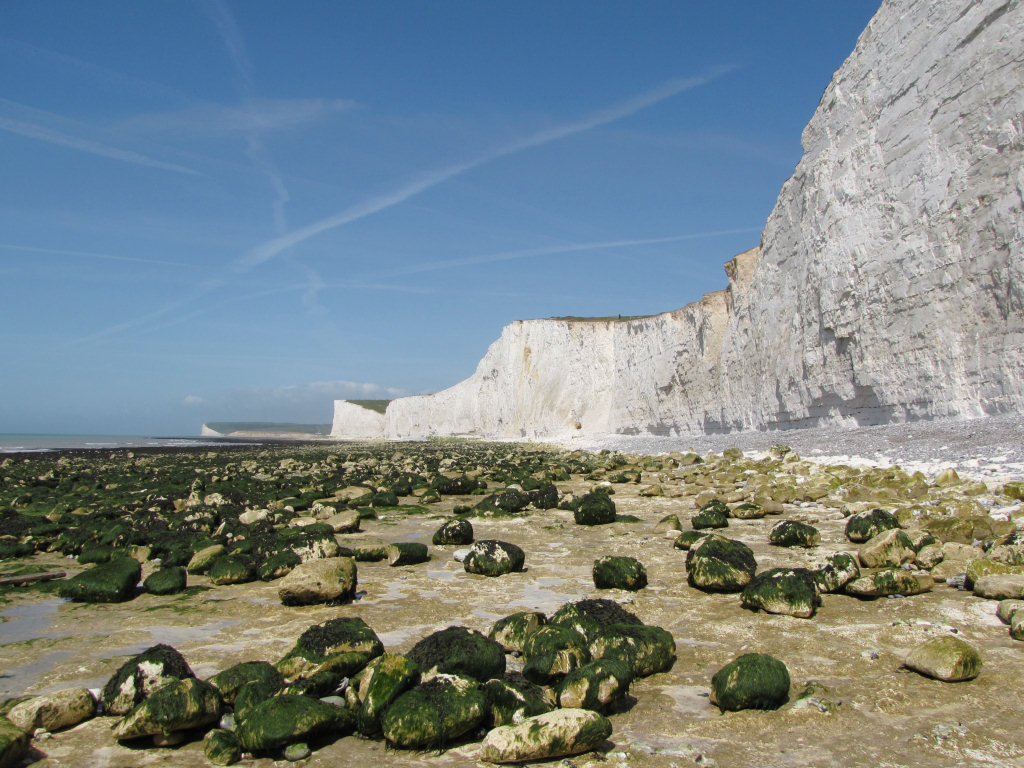
The majestic contour of the Seven Sisters cliff sequence between the River Cuckmere and Birling Gap in East Sussex is among the most spectacular natural scenes in the British Isles. Sculpted by melt-water and heavy rain during recent ice ages, and the erosive power of the sea more recently, the present-day cliffs mark the end of a series of natural inland gulleys.
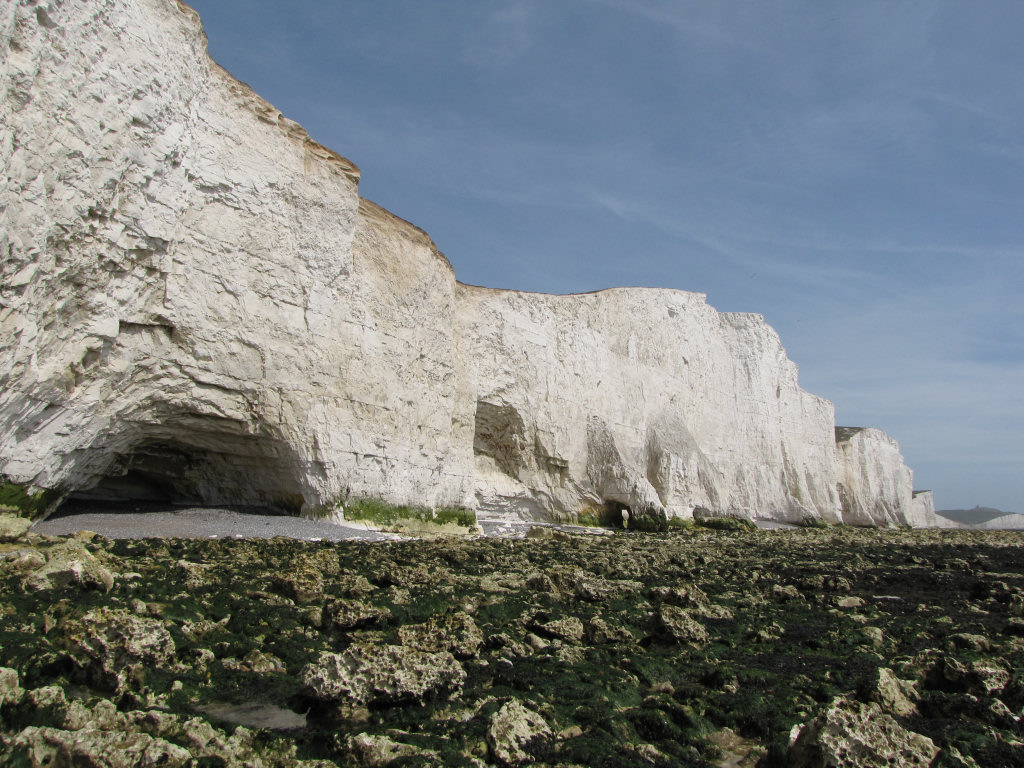 Above: View from the foreshore below Short Brow towards Birling Gap in the distance.
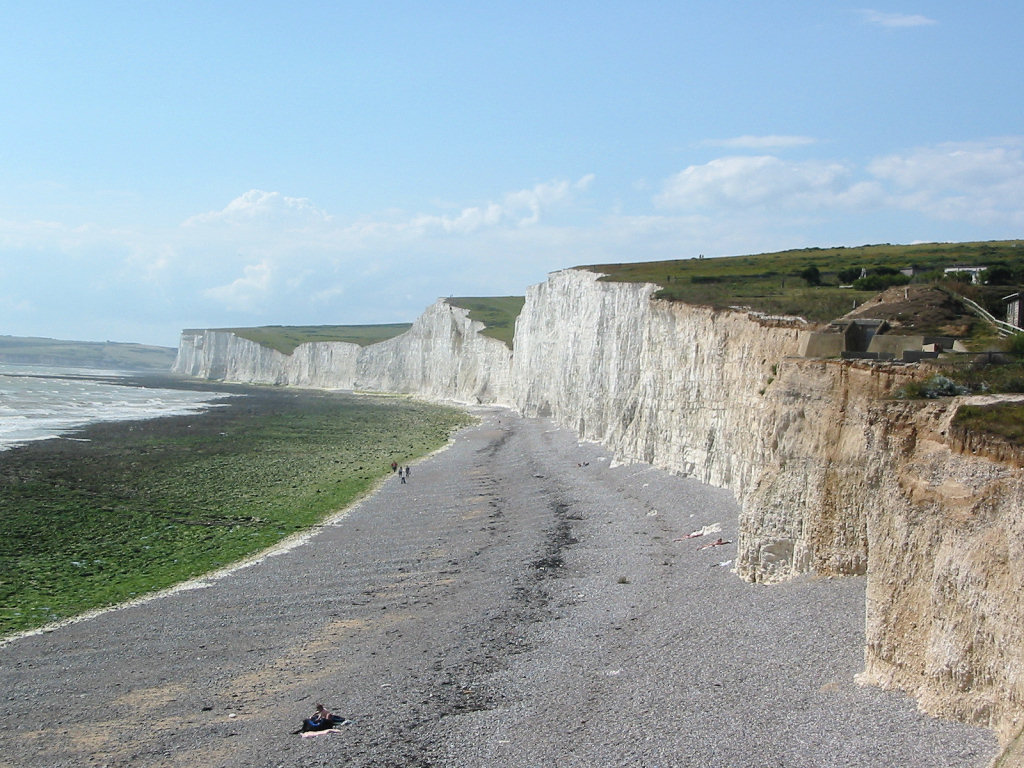 Above: View from Birling Gap across the Seven Sisters cliffs.
The Chalk cliffs and foreshore at Seven Sisters reveals a diverse ecosystem dating from the Late Cretaceous epoch, 87-84 million years ago. Fossils occur commonly throughout the Chalk, in particular echinoids, sponges, bivalves, and other benthic fauna that inhabited the prehistoric seafloor at the time.
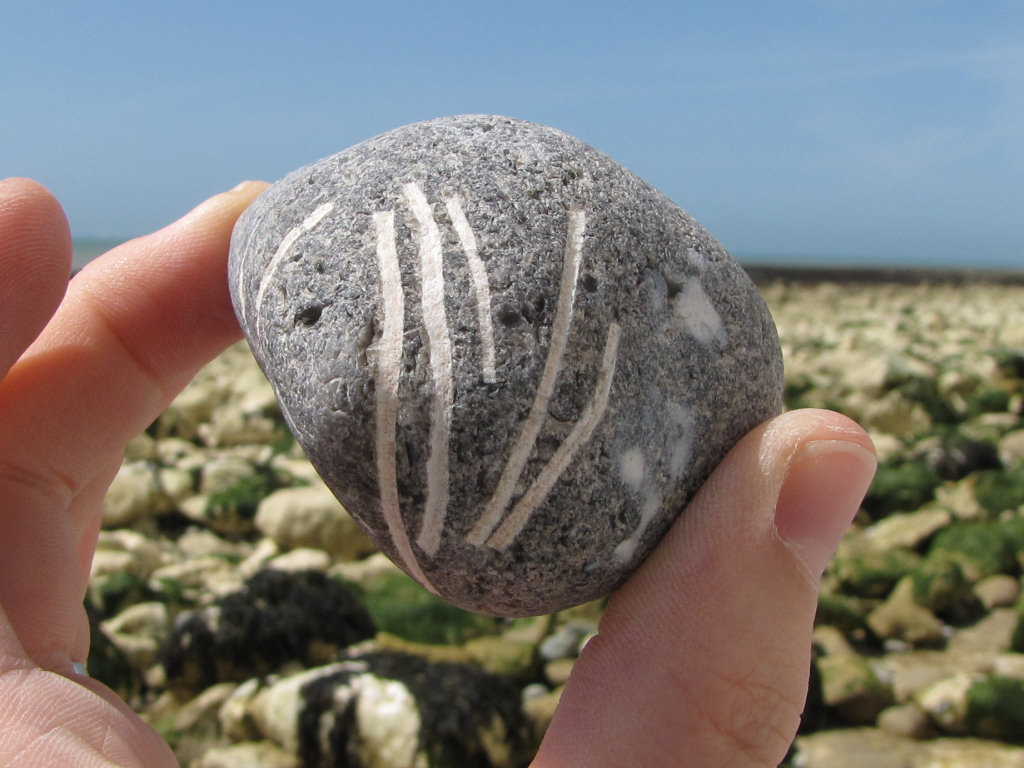 Above: A flint pebble containing fragments of inoceramid bivalve shell(s).
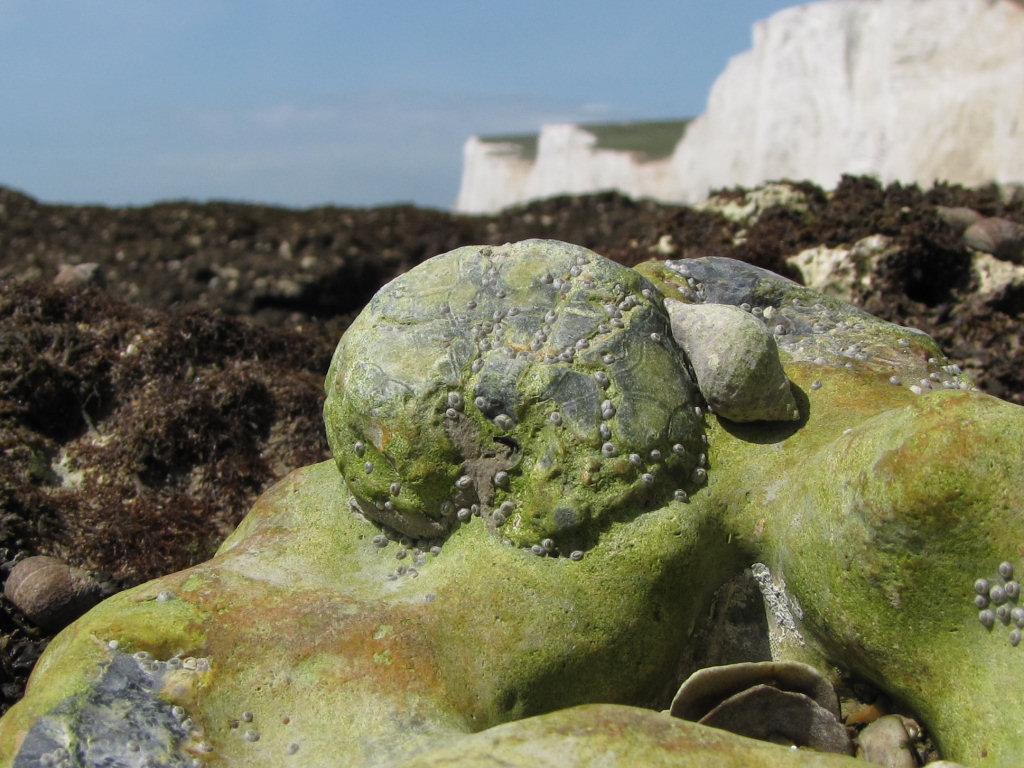 Above: The internal mould of a Micraster irregular echinoid (5cm wide) integrated with a flint nodule.
The most convenient place to access the cliffs and foreshore is at Birling Gap – a cluster of residential properties and a large cafe/pub (below). Plenty of free parking is available throughout the year and a flight of steps provide easy access to the beach (see below).
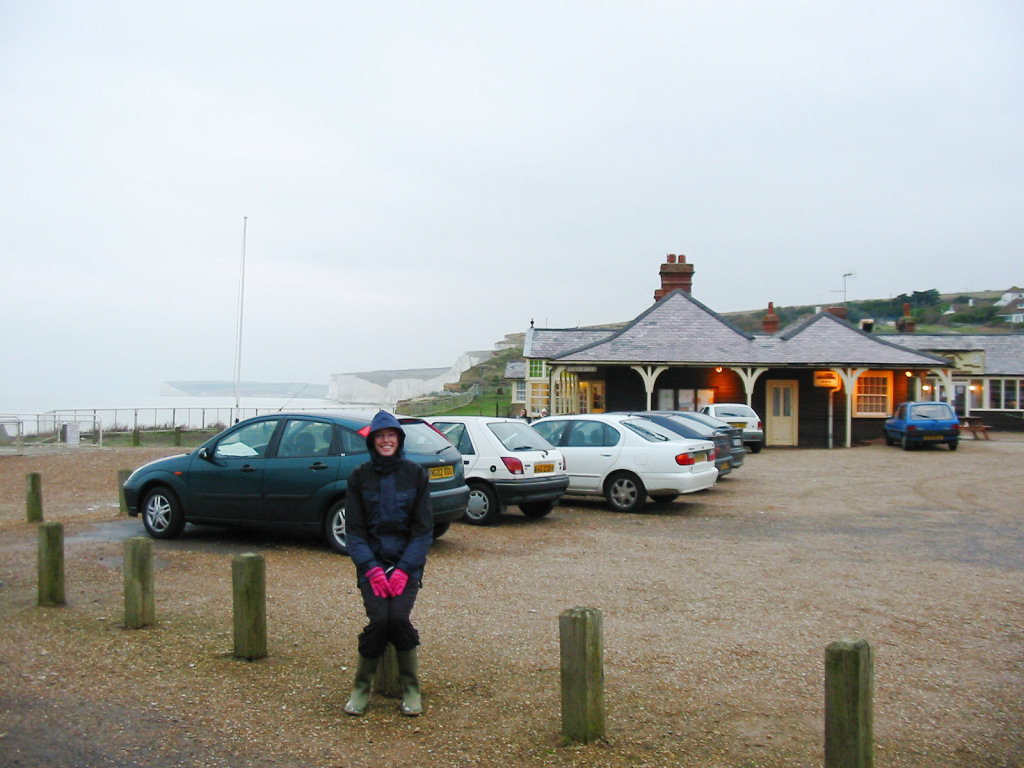 Above: Parking is available alongside the beach access point at Birling Gap. An early Discovering Fossil photo with Lucinda from 2002.
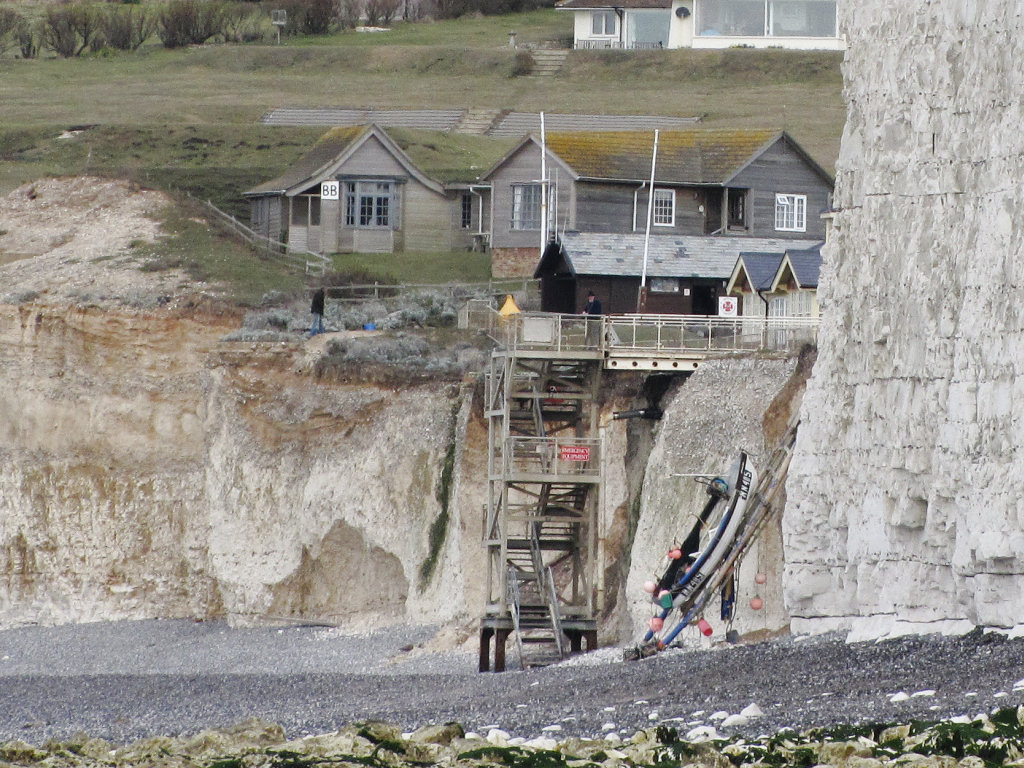 Above: Steps descending to the beach at Birling Gap.
The geology of Seven Sisters
The Chalk at Seven Sisters belongs to the Upper Chalk, and was deposited during the Coniacian and Santonian stages of the Late Cretaceous epoch between 87-84 million years ago (mya). At this time Seven Sisters and much of Great Britain, along with Europe, lay beneath a relatively shallow sea around 40°N of the equator, on an equivalent latitude to the Mediterranean Sea today.
In comparison with present-day conditions, global sea-levels during the Late Cretaceous were over 200 meters higher. The higher sea levels likely reflect a combination of extreme greenhouse conditions and heightened plate tectonics. Elevated plate tectonic activity and the associated volcanics delivered greenhouse gases to the atmosphere, fuelling the greenhouse effect. Global high temperatures melted much (perhaps all) of the ice at high latitudes, introducing significant amounts of water to the world’s oceans. Uplift of the ocean-floor in regions of active plate tectonics displaced further water onto the continental shelves.
The evidence of higher sea levels is reflected in the white Chalk at Seven Sisters. The purity of the Chalk indicates its formation took place far from land, virtually free of terrestrial sands and silts that would otherwise have coloured it. Chalk is largely comprised of the the skeletal remains of planktonic algae known as coccolithophores which accumulated to form a white ooze on the seafloor. This soft sediment was later compacted and hardened (lithified) to form Chalk – a relatively soft rock itself. To discover more about Chalk click here.
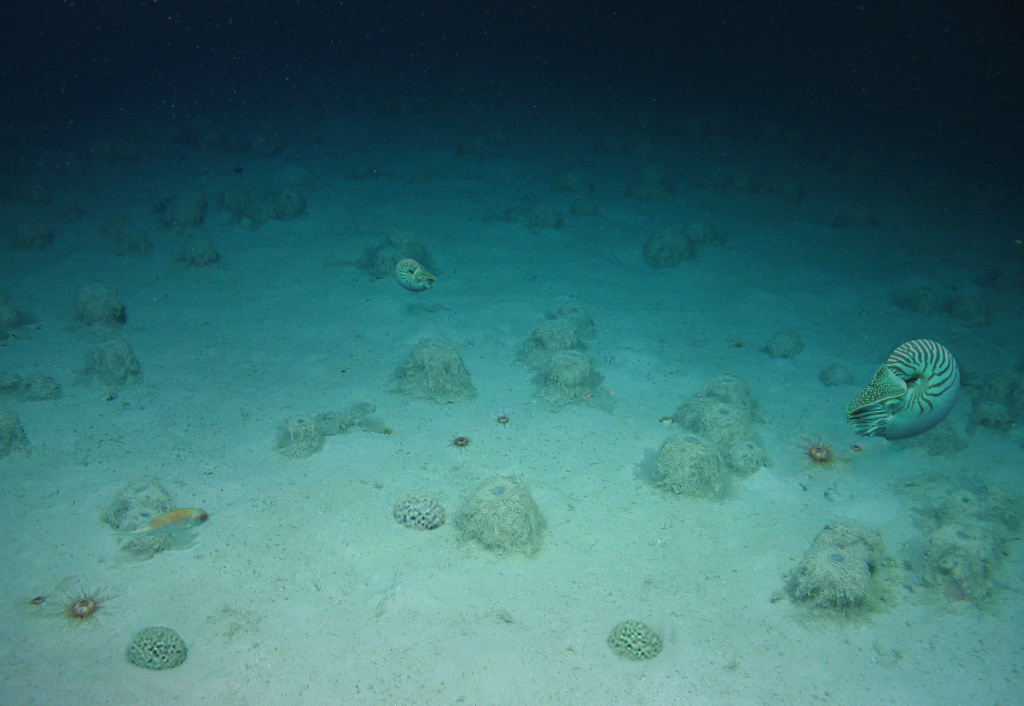 Above: A reconstruction of how the Chalk seafloor might have appeared during its formation. © Discovering Fossils
Today the Chalk appears above sea level, the result of lower present-day sea levels and widespread uplifting caused by the pressure of the European and African continental plates colliding (generating the Alps), a process that took place at its greatest extent 30-25 mya. More recently, following the end of the last ice age and subsequent increase in sea levels (albeit to a less extent than 84 million years ago), the coastline has moved inland, exposing the elevated Chalk to intensive erosion and sculpting it into a vertical cliff-face.
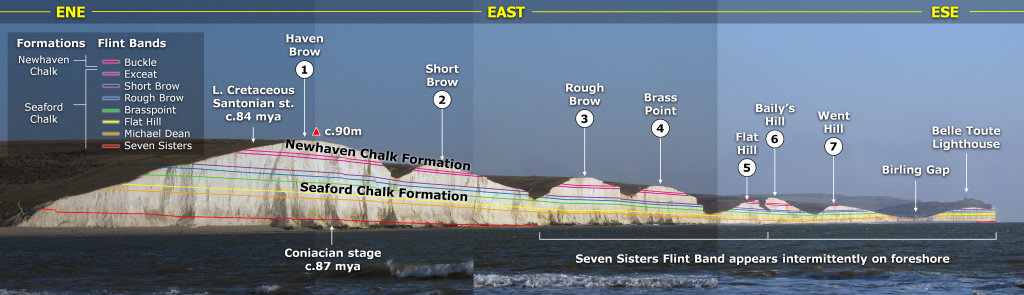 Figure 1: Geology of the cliffs between the River Cuckmere and Birling Gap, and onwards beneath the Belle Toute Lighthouse. Photo taken from Seaford Head.
One of the key markers visible in the cliff-face is the Seven Sisters Flint Band, a conspicuous dark-coloured sheet flint visible within the Seaford Chalk Formation. This particular sheet flint occurs near the cliff-base towards the River Cuckmere and appears intermittently on the foreshore towards Birling Gap.
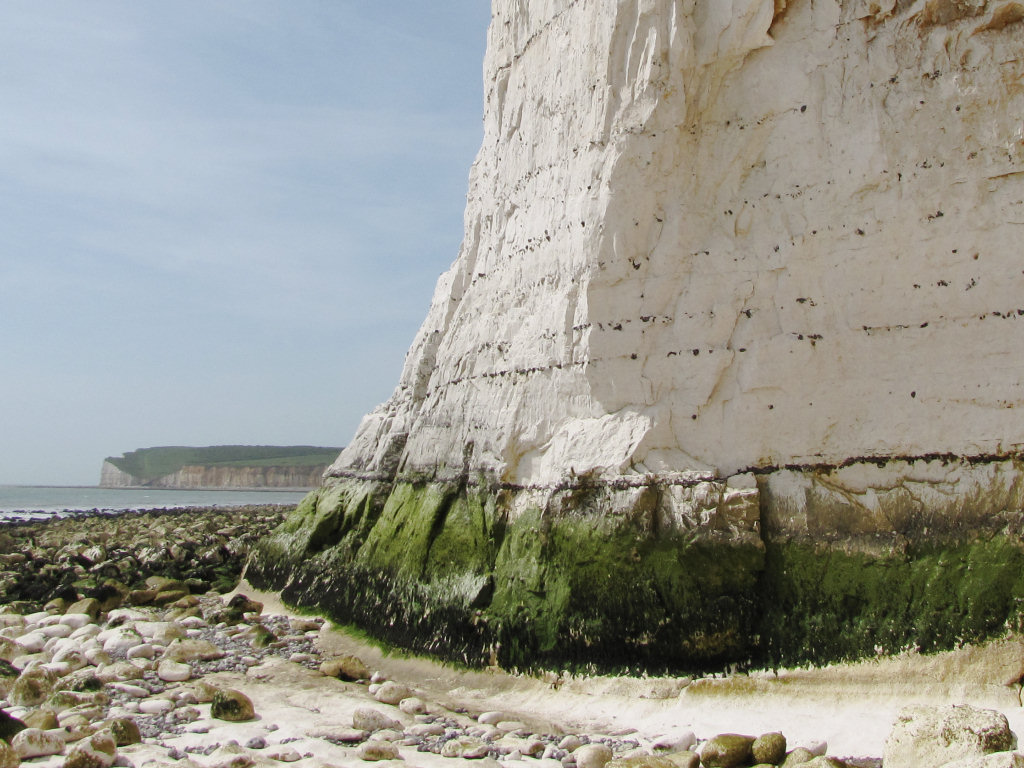 Above: The Seven Sisters Flint Band visible above the green algae towards the base of the cliff beneath Short Brow. Seaford Head in the distance.
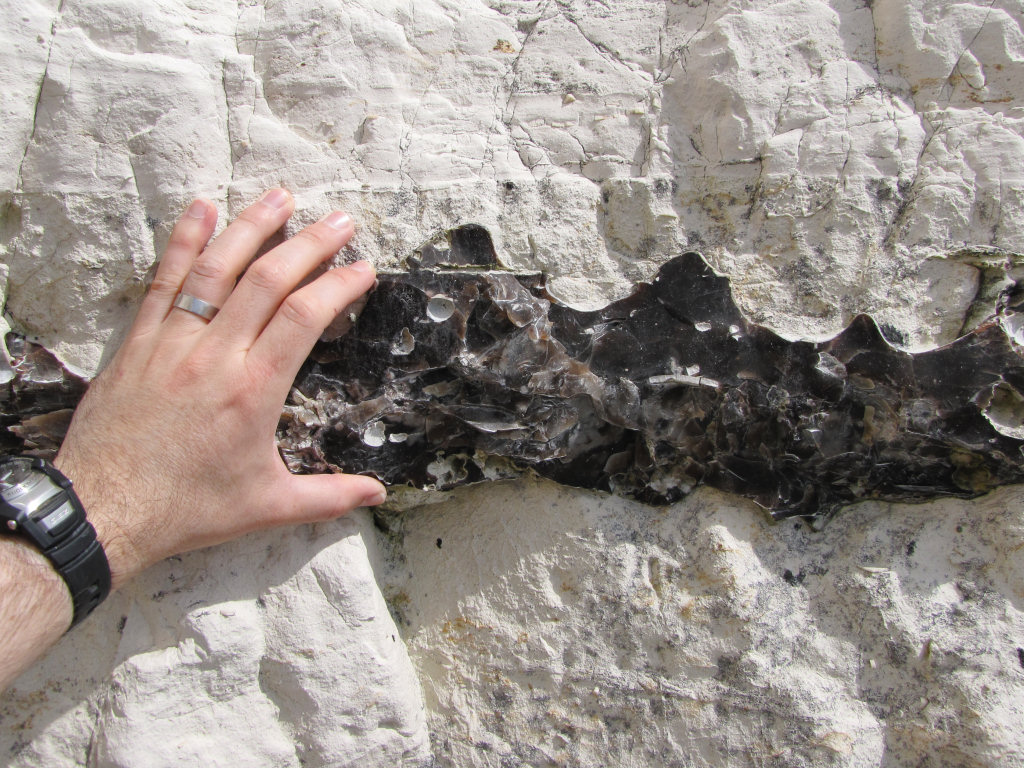 Above: Seven Sisters Flint Band close-up.
Although flint is inorganic, the silica that formed it was originally sourced from the remains of sea sponges and siliceous planktonic micro-organisms (diatoms, radiolarians). Flints are concretions that grew within the sediment after its deposition by the precipitation of silica; filling burrows/cavities and enveloping the remains of marine creatures, before dehydrating and hardening into the microscopic quartz crystals which constitute flint. The photos below illustrate the unique flint-capped Chalk pedestals resulting where the Seven Sisters Flint Band occurs at beach level. To discover more about flint click here.
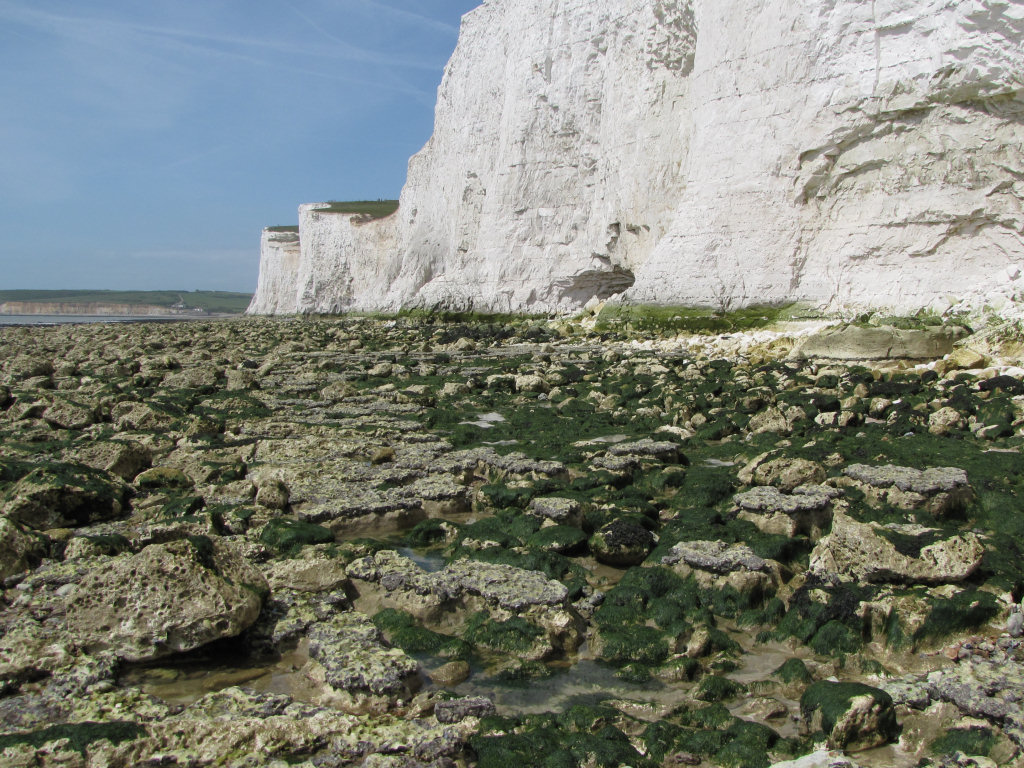 Above: Where the Seven Sisters Flint Band occurs at beach level it forms a hard wearing upper surface on the foreshore.
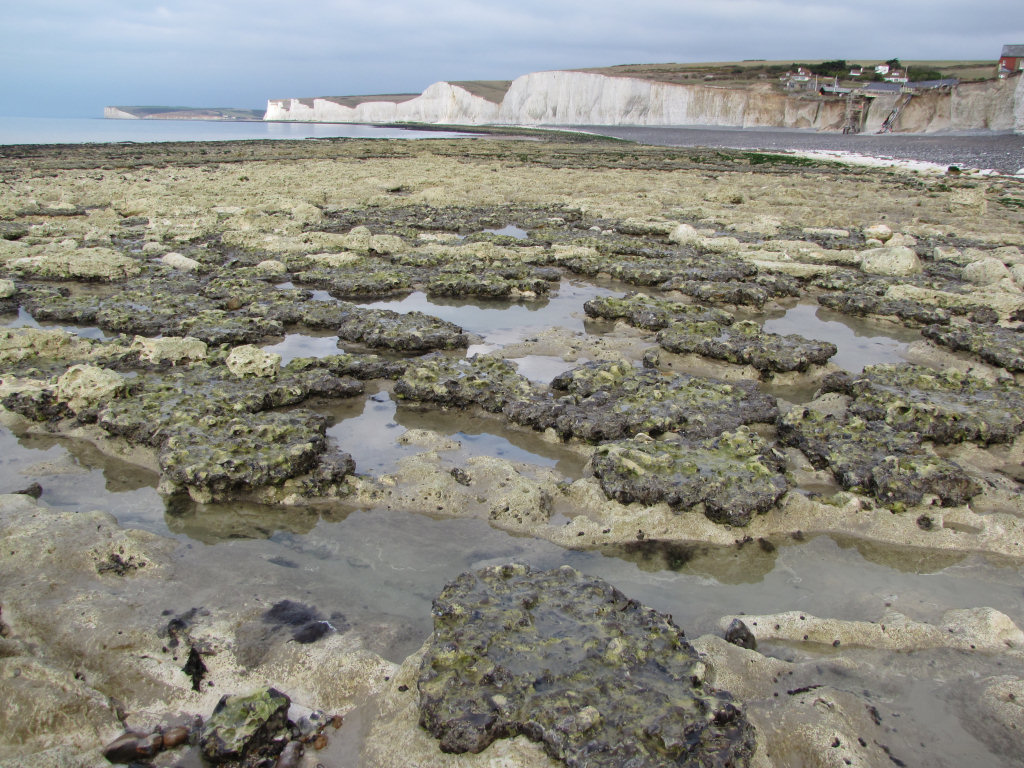 Above: The Seven Sisters Flint Band opposite Birling Gap.
Travelling along the coast from Birling Gap a classic example of a dissolution pipe can be observed at beach level. These structures appear in cross-section as the cliff retreats. Dissolution pipes form as rain water percolates through the overlying Quaternary sediments, becoming increasingly acidic in the process, and dissolving the underlying Chalk as gravity channels the water along natural weaknesses.
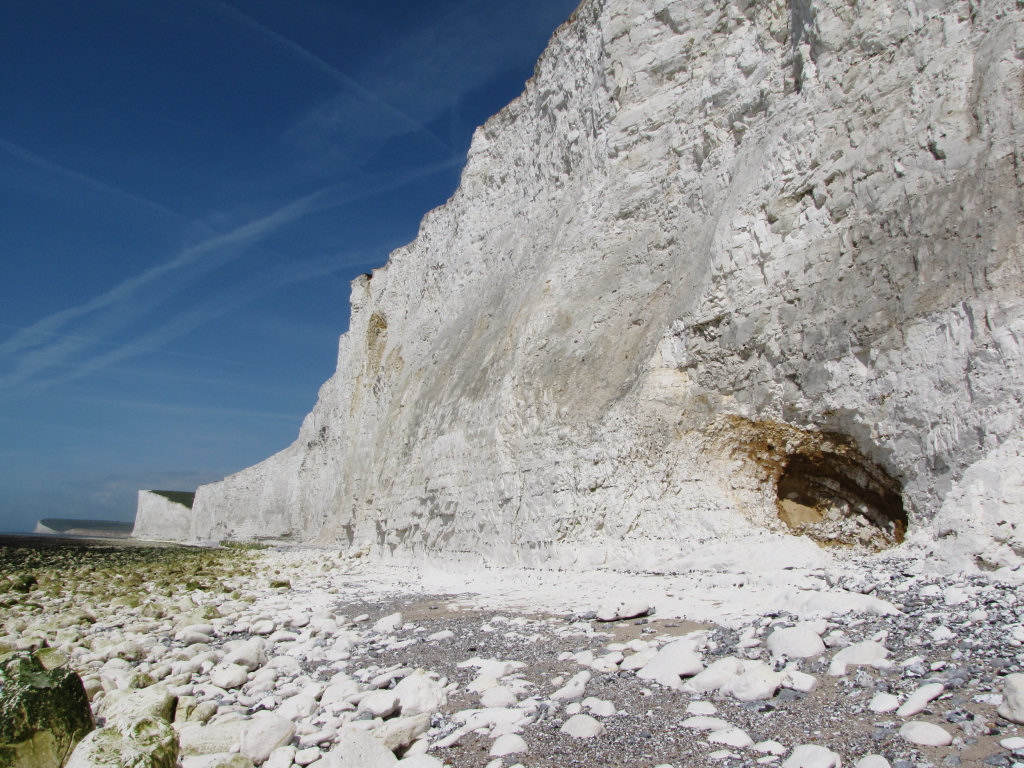 Above: A dissolution pipe travels through the Chalk and exits at beach level.
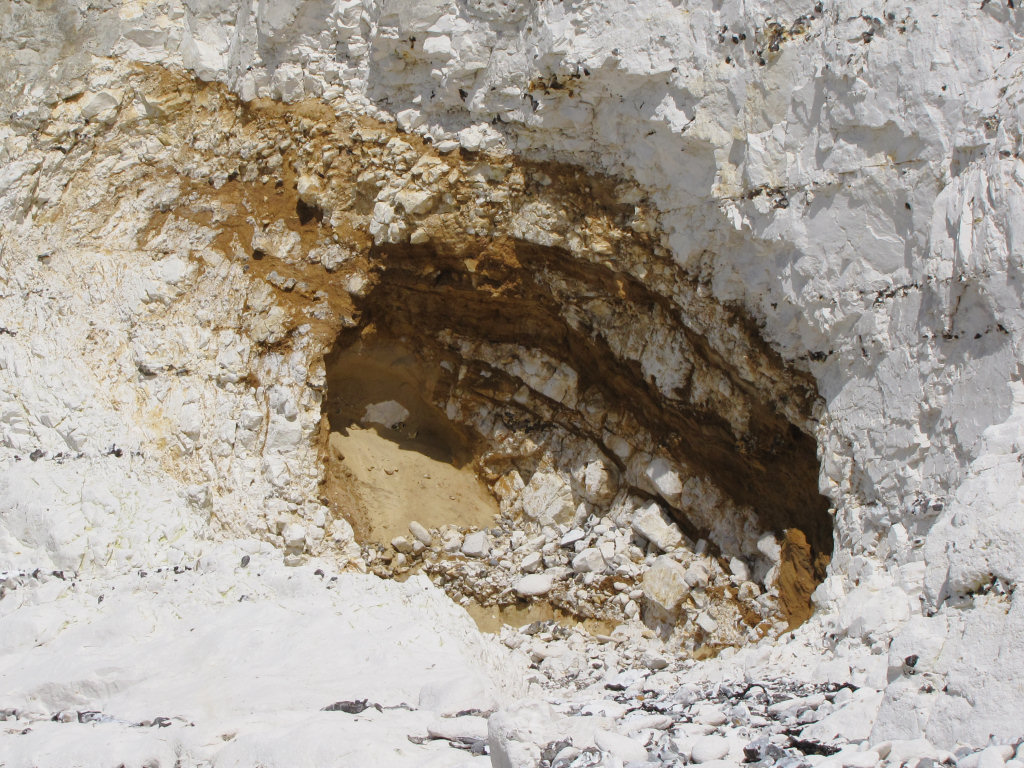 Above: A close-up reveals a high volume of ice-age soil has passed along the pipe.
The overlying orange Quaternary sediments were transported to the area during the most recent ice age, between 115,000 – 10,000 years ago (Devensian stage of the Pleistocene epoch), during which time much of Britain lay beneath a thick ice-sheet. Although the limit of the ice-sheet extended only as far south as Norfolk and the southern parts of Wales, the relative lack of precipitation across the southern area created a mostly inhospitable, wind swept, frozen desert landscape. The freezing winds cut across the exposed land, carrying with them weathered sands and soils. These sediments, known as loess, accumulated in the Chalk valleys of the Seven Sisters area (which had been shaped by earlier ice ages, as melt water eroded the landscape).
Since the return to more temperate conditions and subsequent reduction of ice at higher latitudes, global sea-levels have risen 120m. The advancing sea, known as a marine transgression, has submerged much of the former landmass, shifting the coastline inland and shaping Seven Sisters as we know it.
Where to look for fossils?
Fossils can be found on the foreshore and at the base of the cliffs in either direction from Birling Gap, although for the purposes of this page the focus is towards the northwest (right when looking out to sea). The most productive and safest place to search for fossils is on the foreshore at low-tide. Chalk boulders and flint nodules are scattered along the entire stretch, providing a constant supply of fossils.
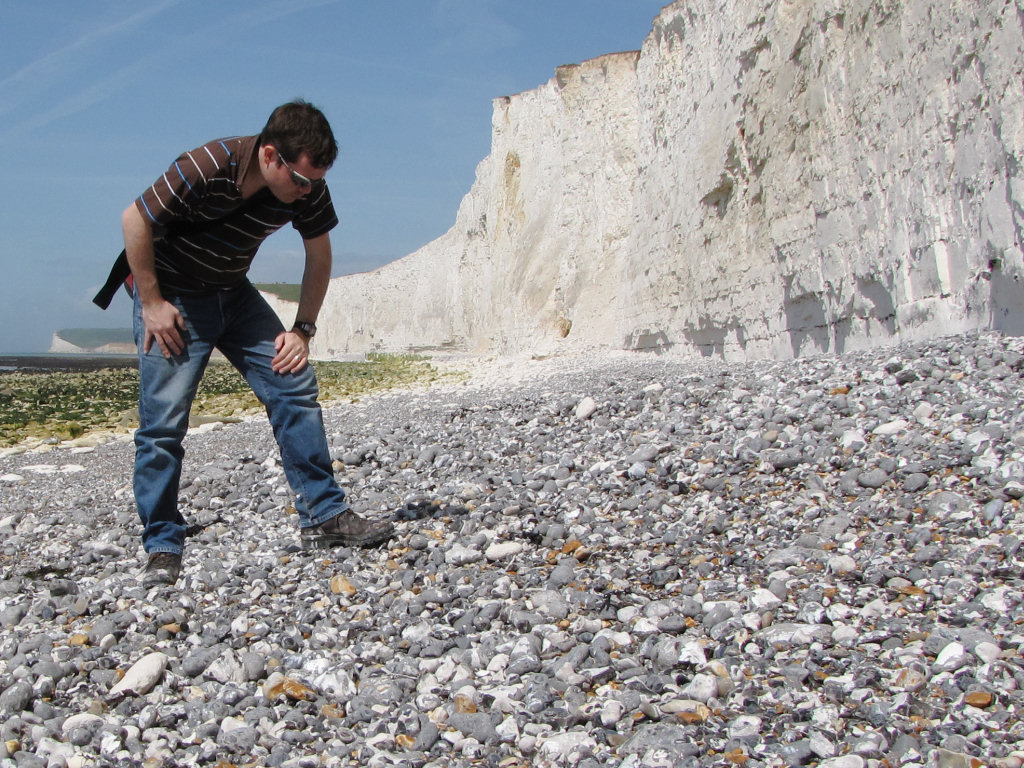 Above: Searching for fossils among and within the flint pebbles on the foreshore.
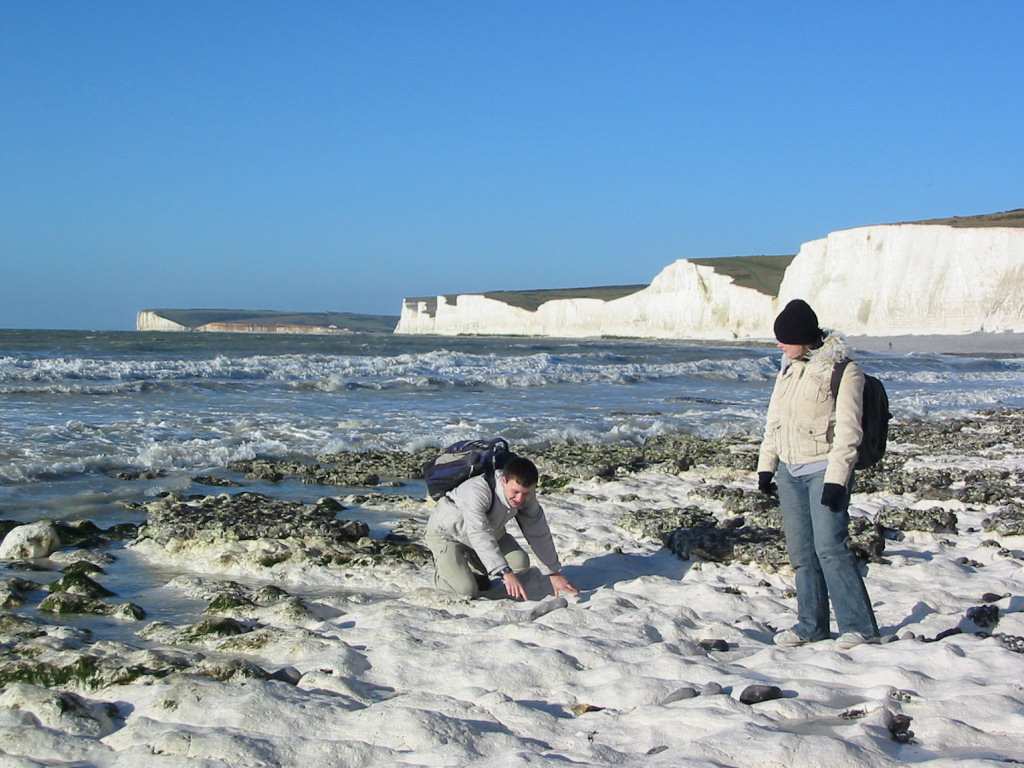 Above: Fossils can be observed in situ and within loose boulders. An early Discovering Fossils photo with Robert & Denise from 2003.
Please note the beach platform and cliffs are assigned SSSI status, which requires visitors avoid damaging (including hammering) the area. From a fossil collecting perspective this means it’s not permitted to extract specimens that are in situ. Collecting efforts should be directed towards the loose boulders and pebbles on the foreshore.
As with all coastal locations, a fossil hunting trip is best timed to coincide with a falling or low-tide. For a relatively low one-off cost we recommend the use of Neptune Tides software, which provides future tidal information around the UK. To download click here. Alternatively a free short range forecast covering the next 7 days is available on the BBC website click here.
What fossils might you find?
Below are a selection of finds between Birling Gap and the River Cuckmere. Among the common finds include echinoids, brachiopods, bivalves and sponges; less common finds include crustacean burrows lined with fish scales and starfish remains (among others).
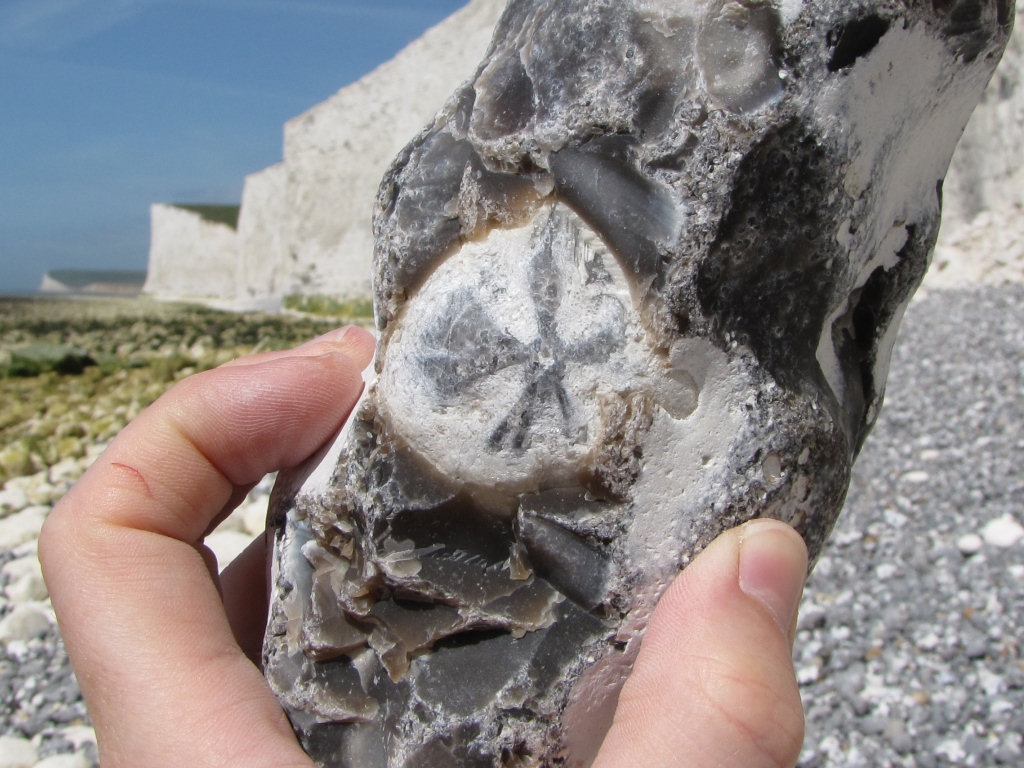 Above: A large flint pebble containing a partially exposed Micraster irregular echinoid.
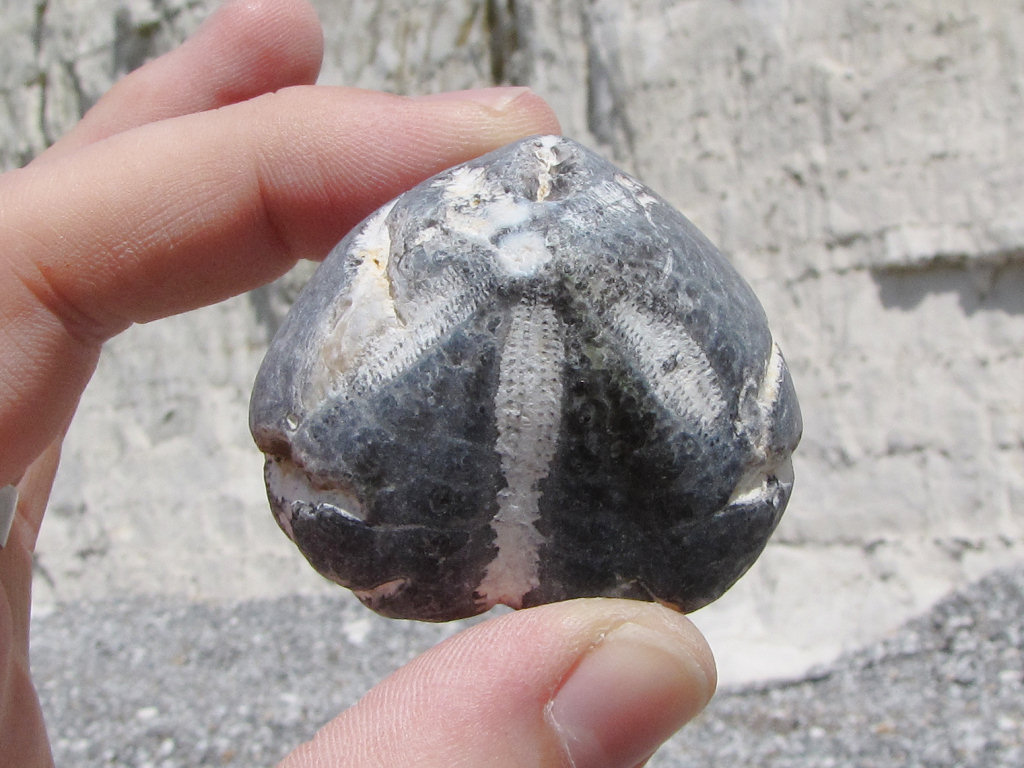 Above: A beach-worn flint Micraster irregular echinoid.
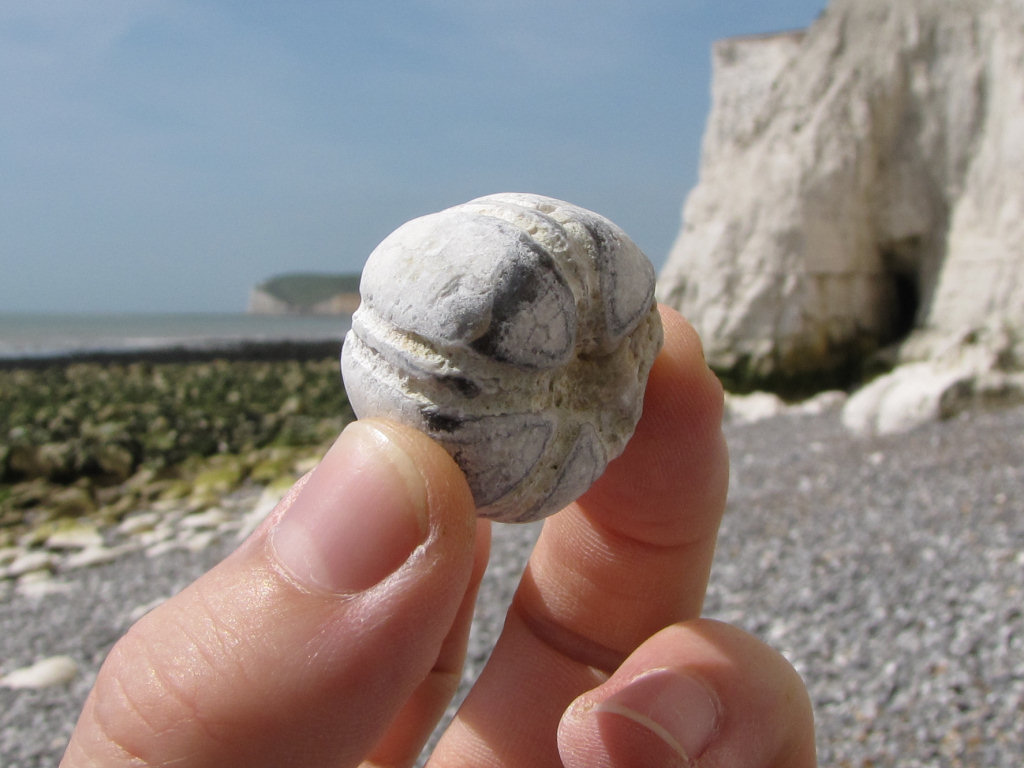 Above: A heavily worn internal flint mould of a Conulus irregular echinoid.
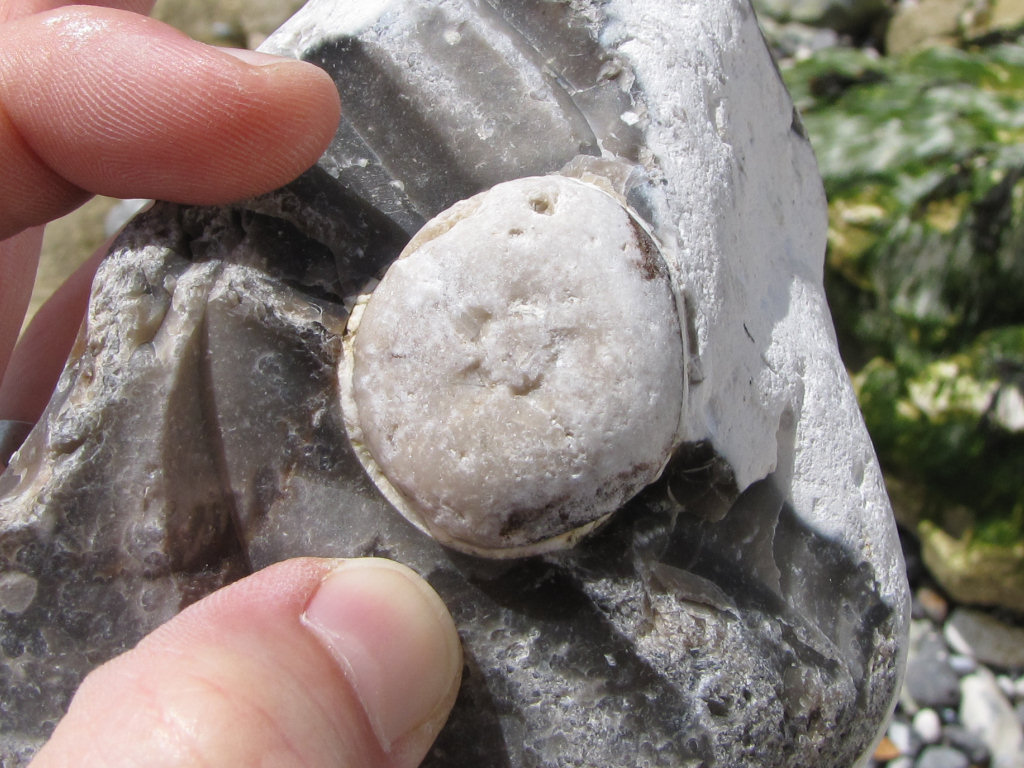 Above: The underside of a Conulus irregular echinoid protruding from a flint nodule.
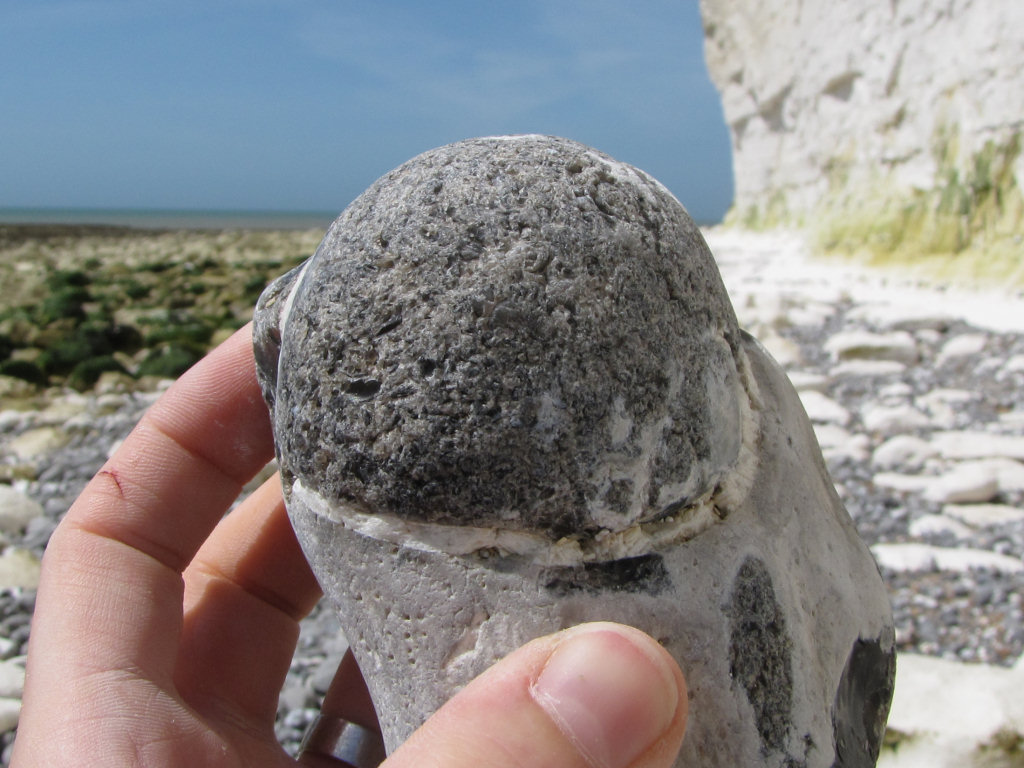 Above: A worn Echinocorys irregular echinoid, the outer shell visible in cross-section along its base.
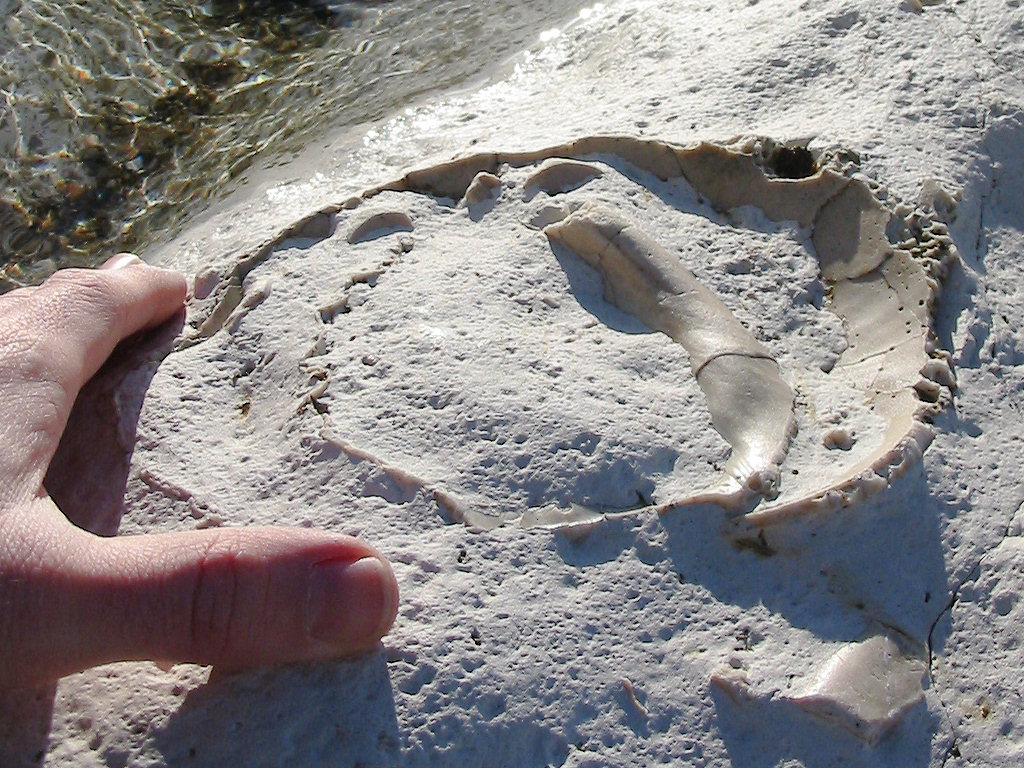 Above: A fragment of inoceramid bivalve shell exposed in situ on the foreshore opposite Birling Gap, Seaford Chalk Formation.
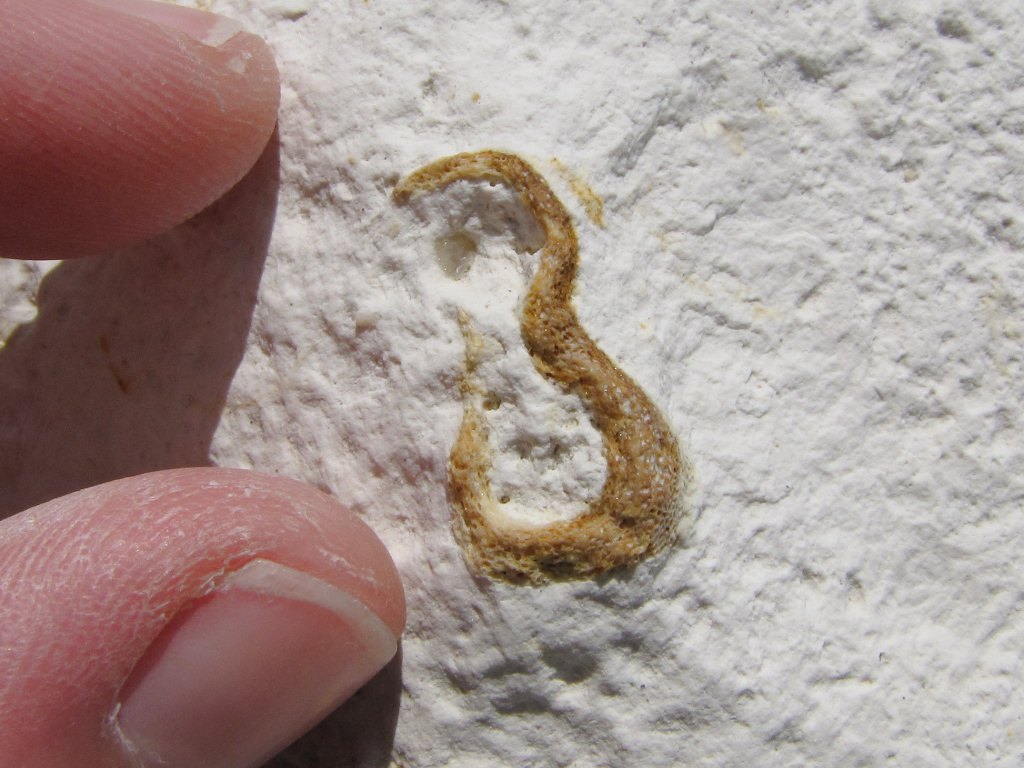 Above: A small sponge exposed on the surface of a foreshore boulder.
Tools & equipment
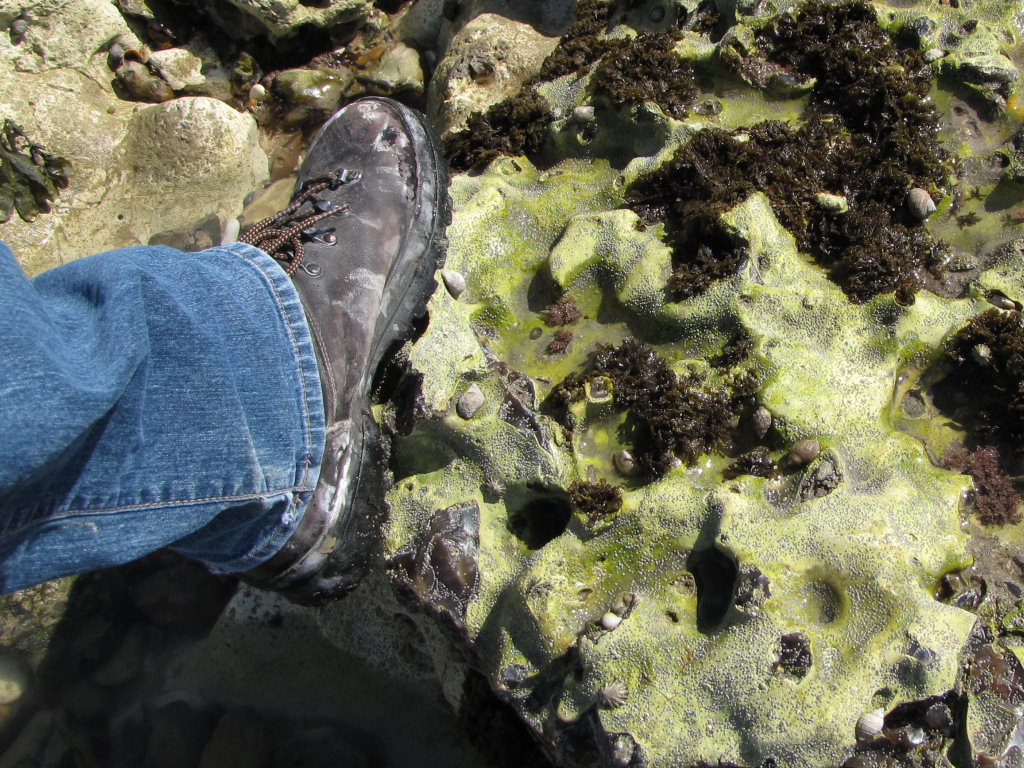 Above: Walking boots are recommended for the rocky terrain.
It’s a good idea to spend some time considering the tools and equipment you’re likely to require while fossil hunting at Seven Sisters. Preparation in advance will help ensure your visit is productive and safe. Below are some of the items you should consider carrying with you. You can purchase a selection of geological tools and equipment online from UKGE.
Hammer: A strong hammer will be required to split prospective rocks. The hammer should be as heavy as can be easily managed without causing strain to the user. For individuals with less physical strength and children (in particular) we recommend a head weight no more than 500g.
Chisel: A chisel is required in conjunction with a hammer for removing fossils from the chalk. In most instances a large chisel should be used for completing the bulk of the work, while a smaller, more precise chisel should be used for finer work. A chisel founded from cold steel is recommended as this metal is especially engineered for hard materials.
Safety glasses: While hammering rocks there’s a risk of injury from rock splinters unless the necessary eye protection is worn. Safety glasses ensure any splinters are deflected away from the eyes. Eye protection should also be worn by spectators as splinters can travel several metres from their origin.
Strong bag: When considering the type of bag to use it’s worth setting aside one that will only be used for fossil hunting, rocks are usually dusty or muddy and will make a mess of anything they come in contact with. The bag will also need to carry a range of accessories which need to be easily accessible. Among the features recommended include: brightly coloured, a strong holder construction, back support, strong straps, plenty of easily accessible pockets and a rain cover.
Walking boots: A good pair of walking boots will protect you from ankle sprains, provide more grip on slippery surfaces and keep you dry in wet conditions. During your fossil hunt you’re likely to encounter a variety of terrains so footwear needs to be designed for a range of conditions.
For more information and examples of tools and equipment recommended for fossil hunting click here or shop online at UKGE.
Protecting your finds
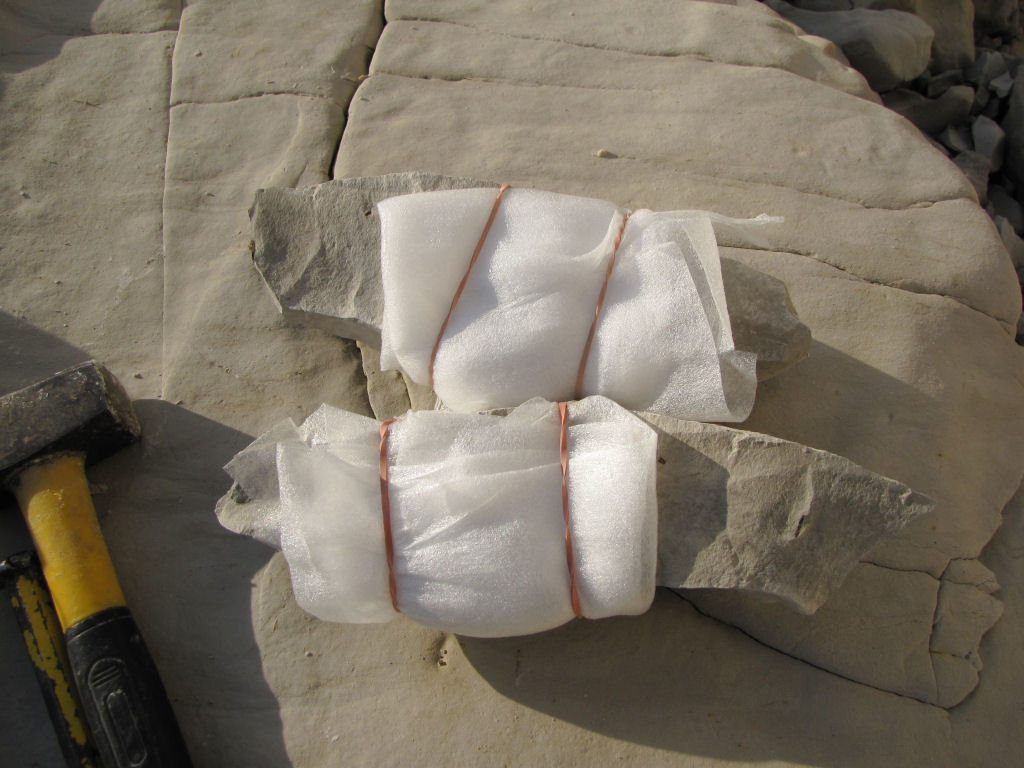
It’s important to spend some time considering the best way to protect your finds onsite, in transit, on display and in storage. Prior to your visit, consider the equipment and accessories you’re likely to need, as these will differ depending on the type of rock, terrain and prevailing weather conditions.
When you discover a fossil, examine the surrounding matrix (rock) and consider how best to remove the specimen without breaking it; patience and consideration are key. The aim of extraction is to remove the specimen with some of the matrix attached, as this will provide added protection during transit and future handling; sometimes breaks are unavoidable, but with care you should be able to extract most specimens intact. In the event of breakage, carefully gather all the pieces together, as in most cases repairs can be made at a later time.
For more information about collecting fossils please refer to the following online guides: Fossil Hunting and Conserving Prehistoric Evidence.
Join us on a fossil hunt
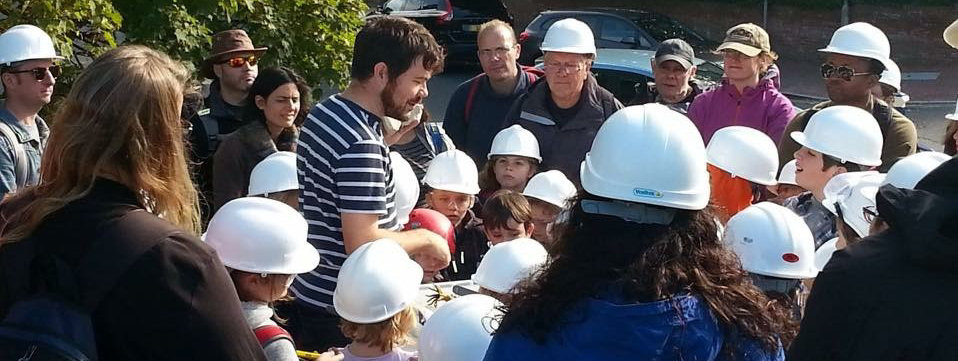
Discovering Fossils guided fossil hunts reveal evidence of life that existed millions of years ago. Whether it’s your first time fossil hunting or you’re looking to expand your subject knowledge, our fossil hunts provide an enjoyable and educational experience for all. To find out more click here.
Page references: A Dynamic Stratigraphy of the British Isles, A. Anderton, P. H. Bridges, M. R. Leeder and B. W. Sellwood, 1992; British Geological Survey, Geology of the country around Brighton and Worthing, B. Young and R. D. Lake, 1988; Geologists’ Association Guide No.57, The Chalk of Sussex and Kent, R. N. Mortimore, 1997; Geological Conservation Review Series, British Upper Cretaceous Stratigraphy, R. N. Mortimore, C. J. Wood and R. W. Gallois, 2001; Fossil of the Chalk, second edition, A. B. Smith and D. J. Batten, 2002; A Geological Time Scale, F. Gradstein, J. Ogg and A. Smith, 2004; www.en.wikipedia.org; www.chalk.discoveringfossils.co.uk.