
Introduction
It would be misleading to describe Littlehampton as a 'fossil
collecting location', as the volume of new beach material
naturally supplied to
the area is relatively low; however it does represent one of many significant
flint pebble beaches that occur along the south and east coasts of
England in particular. Furthermore, the town has a nostalgic significance to both
myself (Roy) and my wife Lucinda, as our home town and early inspiration
for the subject, and for these reasons its geology and fossils are
documented below.
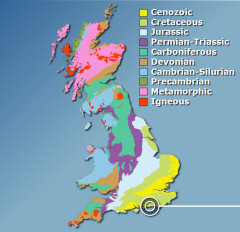
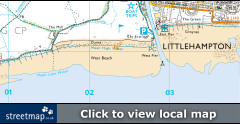
Littlehampton is a seaside town situated on the West Sussex coast,
9 miles east of Chichester and 16 miles west of Brighton. The town
is home to 27,500 people and the destination for many more visitors
seeking the town's sandy beaches and river views. The River Arun
passes through the town and separates the beaches to the east and west;
the east side is popular with tourists due to its accessibility and family facilities,
whereas the west is fringed by sand dunes and is generally more
tranquil.


Left: The view from
the beach access point looking north towards Littlehampton town.
Right: Parking and refreshments are available
alongside the access point.
Access to the beach can be made on either side of the river,
although what new flint material there is, is more prevalent along
the west beach. Parking is available on the west side at the end of Rope Walk, providing immediate access to the beach. Toilets and a small cafe are
also located alongside the car park.
The geology of Littlehampton's pebble beach


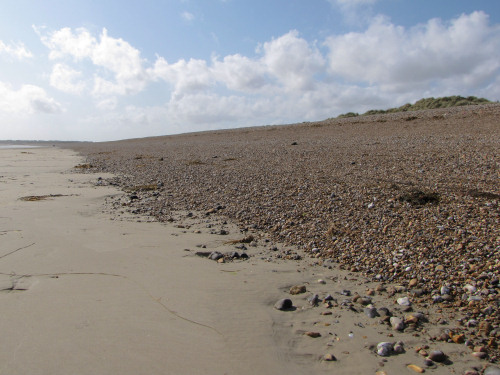
Left: Littlehampton's
west beach continues uninterrupted for 2 miles. Right:
The internal flint mould of an Echinocorys echinoid resting
among other flint pebbles.
The geological history of the Littlehampton area can be traced back
hundreds of millions of years, however the interval of particular
relevance
in this instance began during the Late
Cretaceous epoch between 90-71 million years ago. At this time Littlehampton
and much of Great Britain, along with Europe, lay beneath a relatively
shallow sea
around 40°N of the equator, on an equivalent latitude to the
Mediterranean Sea today.
In comparison with present-day conditions, global sea-levels during
the Late Cretaceous were over 200 meters higher. The higher sea levels
likely reflect a combination of extreme greenhouse conditions and
heightened plate tectonics. Elevated tectonic activity and the
associated volcanics delivered greenhouse gases to the atmosphere,
fuelling the greenhouse effect. Global high temperatures melted much
(perhaps all) of the ice at high latitudes, introducing significant
amounts of water to the world's oceans.
The absence of any nearby landmass meant the primary sediment
accumulating on the seafloor was the tiny skeletons of marine
plankton, known as coccolithophores. These skeletons slowly accumulated to
form a white lime mud. Over time the lime mud was compacted and
hardened, and eventually turned to
chalk rock. The chalk is particularly relevant to this story as the flint formed within it soon after it was deposited, throughout the Late
Cretaceous. To read more about chalk
click here.
Although flint is inorganic, the silica that formed it was
primarily sourced from the remains of sea sponges that grew on the
seafloor. Flints are concretions that grew within the chalk after
its deposition by the precipitation of silica; filling
burrows/cavities and enveloping the remains of marine creatures,
before dehydrating and hardening into the microscopic quartz
crystals which constitute flint. To discover more about flint
click here.
By the end of the Late Cretaceous (65 million years ago) a great volume of chalk and flints
had been deposited/formed, measuring up to 425m thick in the Sussex area.
Since then and in particular between 30-25 million years ago, the southeast of England
(including the Littlehampton area) has been uplifted by the tectonic
forces associated with
the European and African continental plates colliding (generating the
Alps). This uplift was accompanied by
a return to lower sea levels, and the chalk seabed was subsequently exposed and eroded, leaving
the more erosion-resistant flint nodules behind.
More recently, following the end of the last ice age and a
subsequent increase in sea levels (albeit to a less extent than 65 million years ago), the coastline has moved inland,
exposing the
remaining chalk to further erosion and sculpting it into
vertical cliff-faces, as seen nearby at
Seven Sisters for example. This continuous erosion exposes more flint nodules
in the process, replenishing the pebble beaches.
As a result of past and present erosion, the English Channel and the
surrounding river flood plains and chalk valleys contain vast
quantities of loose flints. These flints are transported by
tidal currents and rivers (including the River Arun) to the coastline where they accumulate to form vast
pebble beaches.
At Littlehampton a large reef of flint and chalk pebbles is present approximately
a
mile west of the River Arun, although foreshore exposures are mostly obscured beneath the sand for much of the year. This exposed
reef is the source of the least worn specimens shown below
and perhaps the more worn examples too. It's unclear to what extent the
sea defences constructed west of Climping are having on
the supply of fresh material to Littlehampton's west beach, but it seems
likely that fresh material will accumulate west of Climping
to a greater extent.


Left: A reef of flint and chalk pebbles exposed at low-tide
approximately a mile west of Littlehampton. Right:
A close-up of the reef.


ADVERTISEMENT BY UKGE - OFFICIAL ADVERTISING PARTNER OF DISCOVERING FOSSILS
Where to look for fossils?
Fossils can be found along the entire pebble beach between
Littlehampton and Climping in the west (and beyond). The best time to visit is
during a falling tide when the full expanse of pebbles is visible,
however even when the tide is at its highest there's usually sufficient
pebbles at the top of the beach to explore. For a relatively low
one-off cost we recommend the use of Neptune Tides software, which
provides future tidal information around the UK. To download a free
trial
click here.
Alternatively a free short range forecast covering the next 7 days
is available on the BBC website
click here.


Left: Fossils can be found among the pebbles
towards the
top of the beach. Right: Looking east along the
beach towards the River Arun.
It's apparent when exploring the beach that the repeated tidal
action of the sea has graded the pebbles into areas of similar
size. For example the proportion of larger pebbles is
generally greatest towards the River Arun end of the beach, likewise the
larger pebbles tend to occur in graded horizontal bands as shown in
the photo below-right.


Left: The pebbles at
the river end of the beach tend to include a greater proportion of
large pebbles. Right: Larger pebbles occur in
visible horizontal bands.
Large pebbles are important as they generally contain a higher
volume of complete specimens, in particular the internal flint
moulds of echinoids which
typically measure around 5cm (2 inches) across. Fossils can of course be observed
on the surface of smaller pebbles however these are often partial or
badly worn.
What fossils might you find?
The fossils at Littlehampton reveal the variety of organisms
living on the seabed 90-71 million years ago. Among the
more frequent finds include the internal flint moulds of two
irregular (bilaterally-symmetrical) echinoid genera - the heart-shaped
Micraster and the taller, oval-shaped Echinocorys. In
life these particular echinoids were covered with small hair-like spines,
which they used to propel themselves through the sediment in search
of food. These spines are always absent from internal flint moulds,
however specimens found in situ within the chalk elsewhere,
occasionally include a small number of spines.


Left: A relatively
unworn Echinocorys echinoid, note the white test is
retained and very little of the internal flint mould is visible.
Right: The test has been largely worn away from
this Echinocorys echinoid, leaving the internal flint mould.


Left: Echinoids such
as this Echinocorys began life in a planktonic state,
however fossil specimens below 2.5cm are less common.
Right: Some Echinocorys grew to
the size of a tennis ball, including this specimen within a large
chalk pebble (note that flint is absent from this example).


Left and right:
Beach-worn internal flint moulds of irregular Micraster
echinoids,
found loose among the pebbles.


Left: An exquisite flint Conulus
echinoid. Right: The underside view, showing the
central opening in the test through which it fed and the anus on the
right.
Evidence of other echinoids that inhabited the seafloor include
the regular (radially-symmetrical) Cidarid echinoids. Unlike the
aforementioned irregular echinoids, which spent their lives burrowing within
the sediment, regular echinoids grazed on the seabed. This exposed
lifestyle leaves the regular echinoids more exposed to predators,
including starfish and fish in particular, subsequently these
echinoids possess large defensive spines that help shield them from attack. The spines
are also used for
locomotion and to right the echinoid from an upturned position -
following attack for example. Complete tests with associated
spines are very rare, it's more common to find the impressions of
test fragments and isolated spines on the
surface of flint pebbles.


Left: The
impression of partial Prinonocidaris(?) regular chinoid
test. The
centre of the plates are the attachment points of the
spines.
Right: The
impression of partial Temnocidaris(?) regular echinoid test.


Left: The impression
of a spine belonging to a regular echinoid Temnocidaris. Right:
A second spine impression Tylocidaris.
As well as echinoids, other benthic (seafloor dwelling)
organisms include crinoids (very rare), bivalves, brachiopods and
sponges. Flint is also notorious for appearing to resemble other
organic structures, such as the pseudo human skull towards the
bottom of the page.


Left: The impression
of a Marsupites crinoid calyx plate. Flint impressions such
as this are very rare.
Right: A flint pebble containing three
Marsupites crinoid calyx plates.


Left: A
near-complete internal mould of the Spondylus bivalve, visible on both sides of a
flint nodule. Specimens from the chalk possess long spines.
Right: A flint pebble
containing fragments of an inoceramid bivalve shell - visible in
section as narrow white bands and voids.


Left: A brachiopod shell on the surface of a flint
pebble. The shell has not been preserved, resulting in a narrow void between the
internal and external moulds.
Right: A
largely intact fossilised sponge encased by flint.


Left: A pseudo
fossil, actually a banded flint pebble. These formations are not yet
fully understood, however they are thought to occur during
crystallisation.
Right: A pseudo fossil skull, actually the 'eyes'
and 'mouth' represent
the spaces previously occupied by fossil sea sponges.


ADVERTISEMENT BY UKGE - OFFICIAL ADVERTISING PARTNER OF DISCOVERING
FOSSILS
Protecting your finds
It's important to spend some time considering the best way to
protect your finds onsite, in transit, on display and in storage.
Prior to your visit, consider the equipment and accessories you're
likely to need, as these will differ depending on the type of rock,
terrain and prevailing weather conditions.


Left: Fossil
wrapped in foam, ready for transport. Right:
A small compartment box containing cotton wool is ideal for
separating delicate specimens.
When you discover a fossil, examine the surrounding matrix (rock)
and consider how best to remove the specimen without breaking it;
patience and consideration are key. The aim of extraction is to
remove the specimen with some of the matrix attached, as this will
provide added protection during transit and future handling;
sometimes breaks are unavoidable, but with care you should be able
to extract most specimens intact. In the event of breakage,
carefully gather all the pieces together, as in most cases repairs
can be made at a later time.
For more information about collecting fossils please refer to the
following online guides:
Fossil Hunting and
Conserving Prehistoric Evidence.
Join us on a fossil hunt


Left: A birthday party with
a twist - fossil hunting at
Peacehaven.
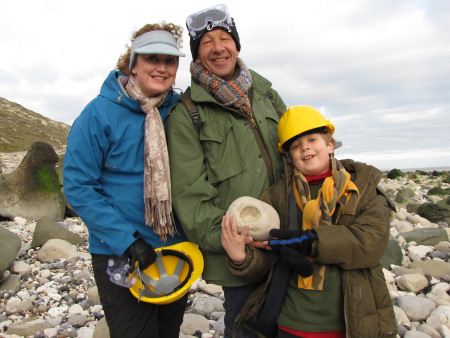
Right: A family hold their prized ammonite at Beachy Head.
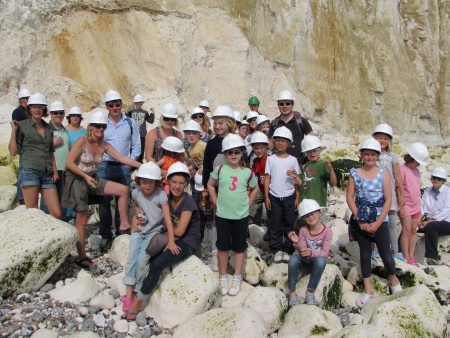
Discovering Fossils guided fossil hunts reveal evidence of life that
existed millions of years ago. Whether it's your first time fossil
hunting or you're looking to expand your subject knowledge, our fossil
hunts provide an enjoyable and educational experience for all. To find
out more
CLICK HERE