Introduction
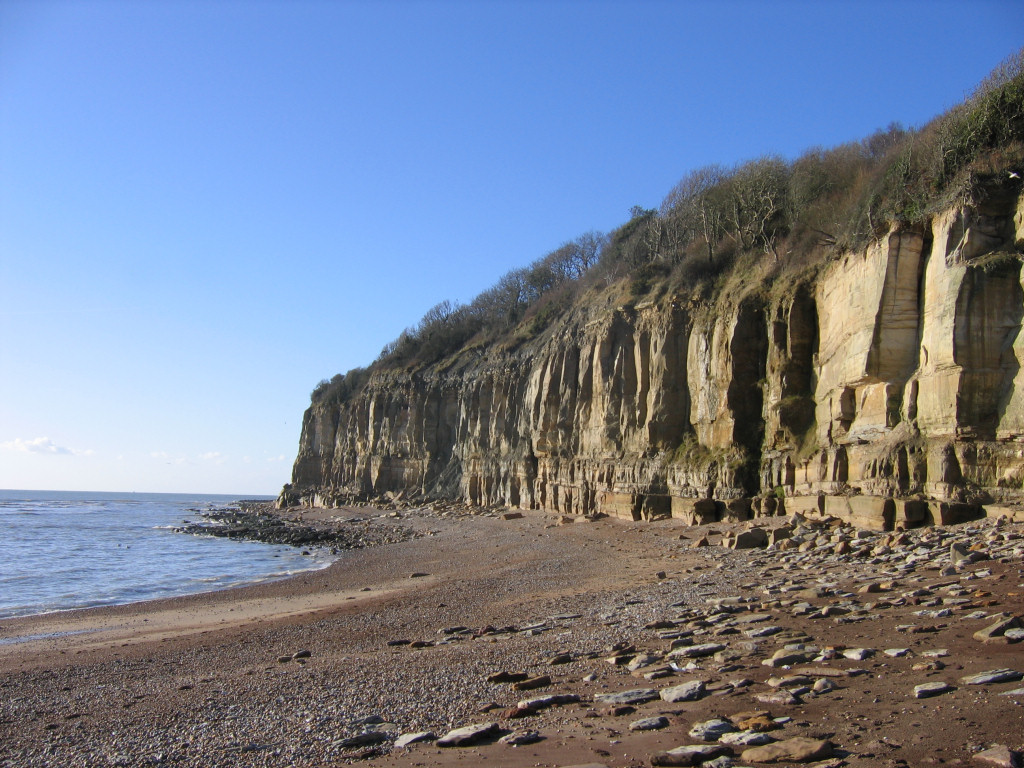
Fairlight is a small village located a short distance from the coast between Pett Level (half a mile to the north-east) and Hastings (4 miles to the south-west).
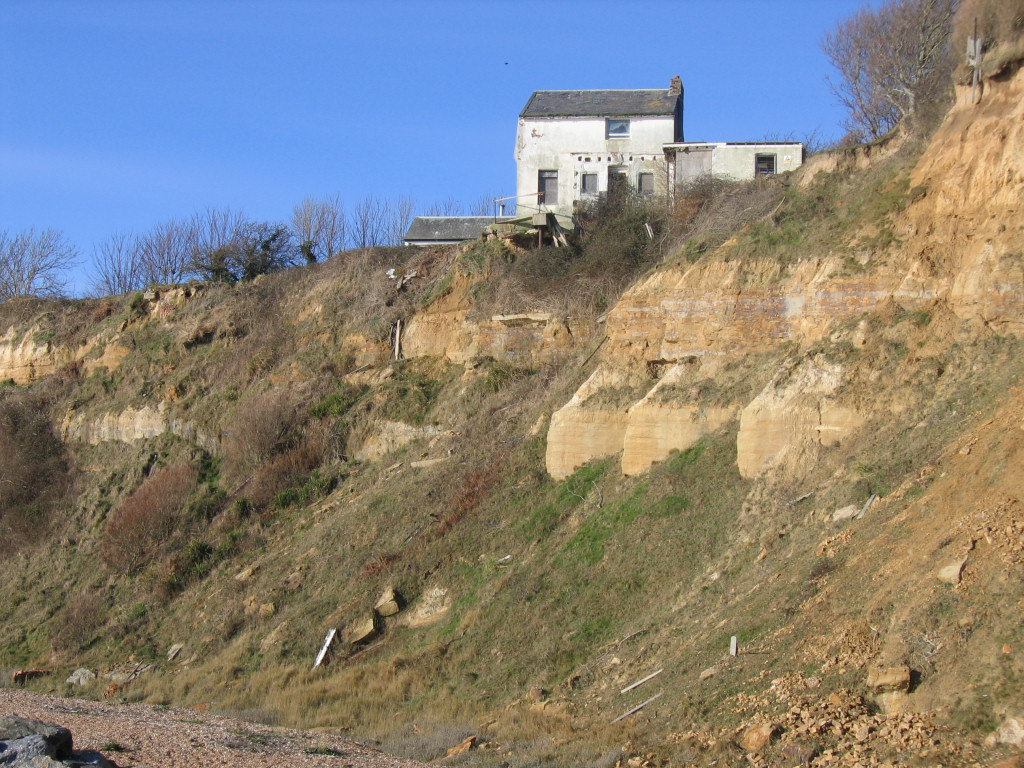
Over the years coastal erosion has consumed much of the village outskirts and several homes have already toppled over the cliff. A recent study revealed the cliffs had retreated over 100 metres in the last century alone. Until recently Fairlight was unprotected from the sea, but in the early 1990s a project to construct a wave barrier was completed. Today, erosion remains a big problem for the local inhabitants, but is now confined to the stretches either side of the barrier and the foreshore immediately in front of it.
The cliffs and foreshore are comprised of layers of sandstone and clay, deposited during the Early Cretaceous epoch, approximately 140 million years ago (mya).
Fossils can be found along the entire coastal stretch between Pett Level and Hastings. Among the finds made over the years include: dinosaur bones and footprints, horsetail stems and other plants, fresh-water bivalves, and fish remains. Although dinosaur remains are less common, when they are discovered their importance is usually very high – please notify Discovering Fossils or the Natural History Museum in London if you discover something of importance.
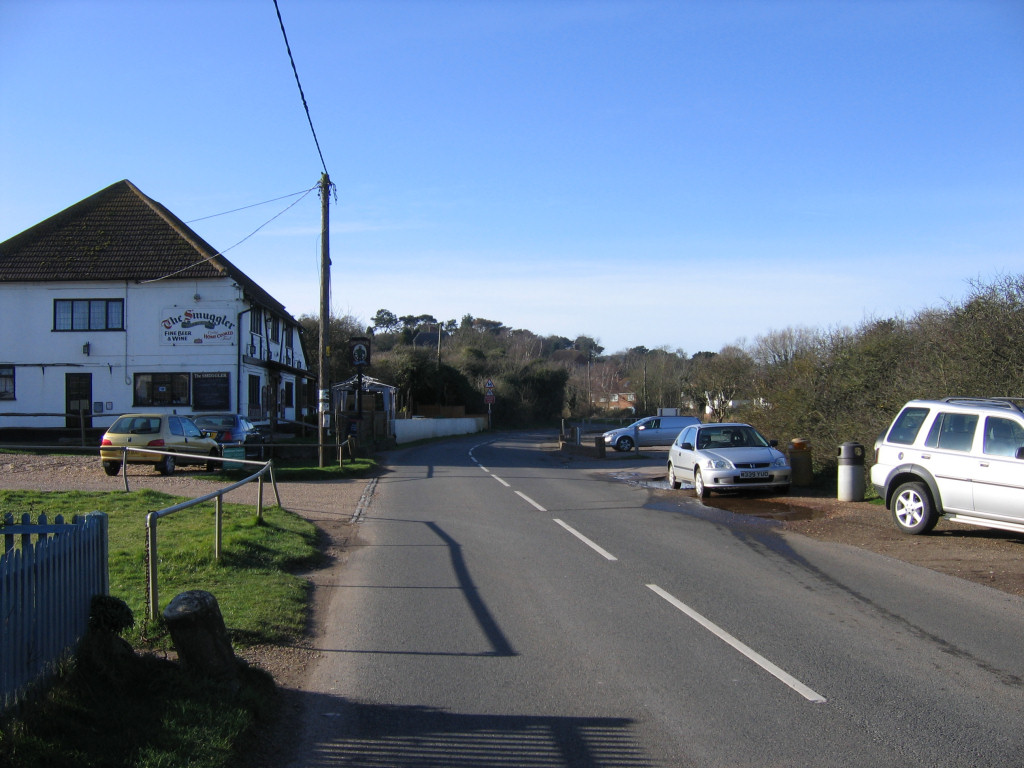
Access to the beach is made a short distance east of Fairlight at Pett Level. From the coast road a small access road (running alongside The Smuggler pub) leads to the beach. Parking is available along the main road opposite the pub (as seen above).
The cliffs at Pett Level and Fairlight are extremely unstable, falling rocks and large collapses occur without warning throughout the year. Please take care during your visit and avoid standing directly beneath the cliff. It’s recommended to keep at least 8 metres from the cliff base; if your visit requires that you operate within this we strongly advise the use of a hard hat.
The geology of Fairlight
Fairlight provides an opportunity to explore part of the Early Cretaceous epoch, a time in the earth’s history dating approximately 143-139 mya. There are two geologic stages present within the cliff and foreshore: the Berriasian (approximately 145-140 mya) and the Valanginian (approximately 140-136 mya), although the precise transition between the two is not clearly defined (figure 1).

The sediments exposed in the cliffs and on the foreshore between Pett Level and Hastings were originally transported to the area as sands and silts by rivers and streams, before settling at the base of a large lake or lagoon (predominantly above sea level). At this time Fairlight and the rest of Britain were part of the European landmass, located around 40° north of the equator, on the same latitude as the Mediterranean Sea is today.
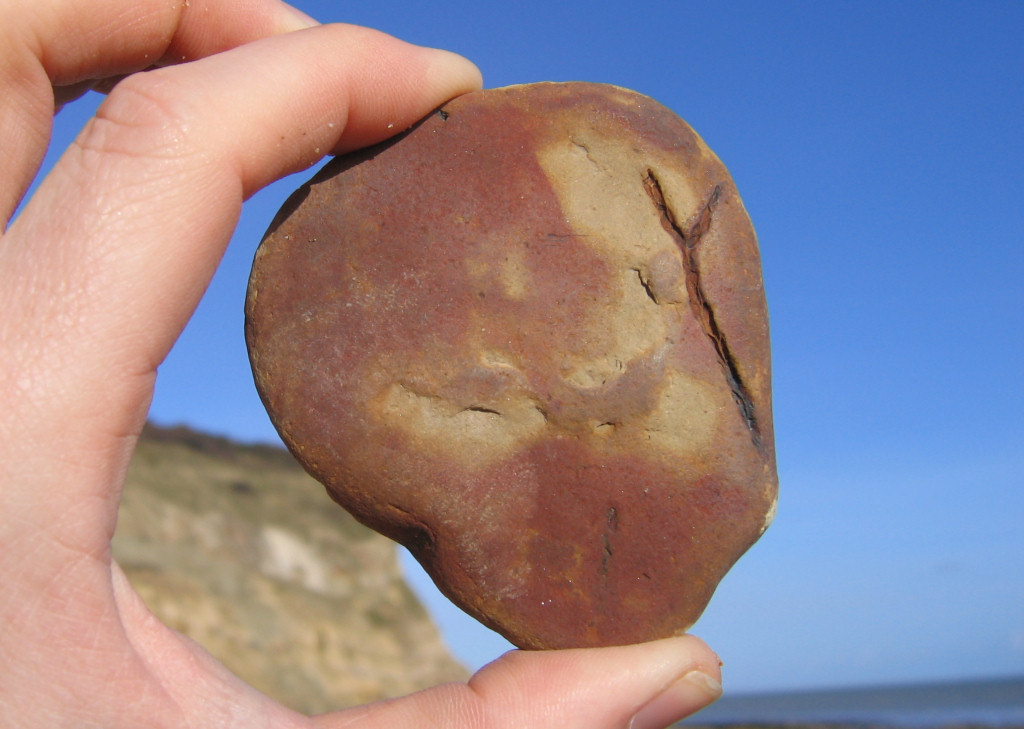
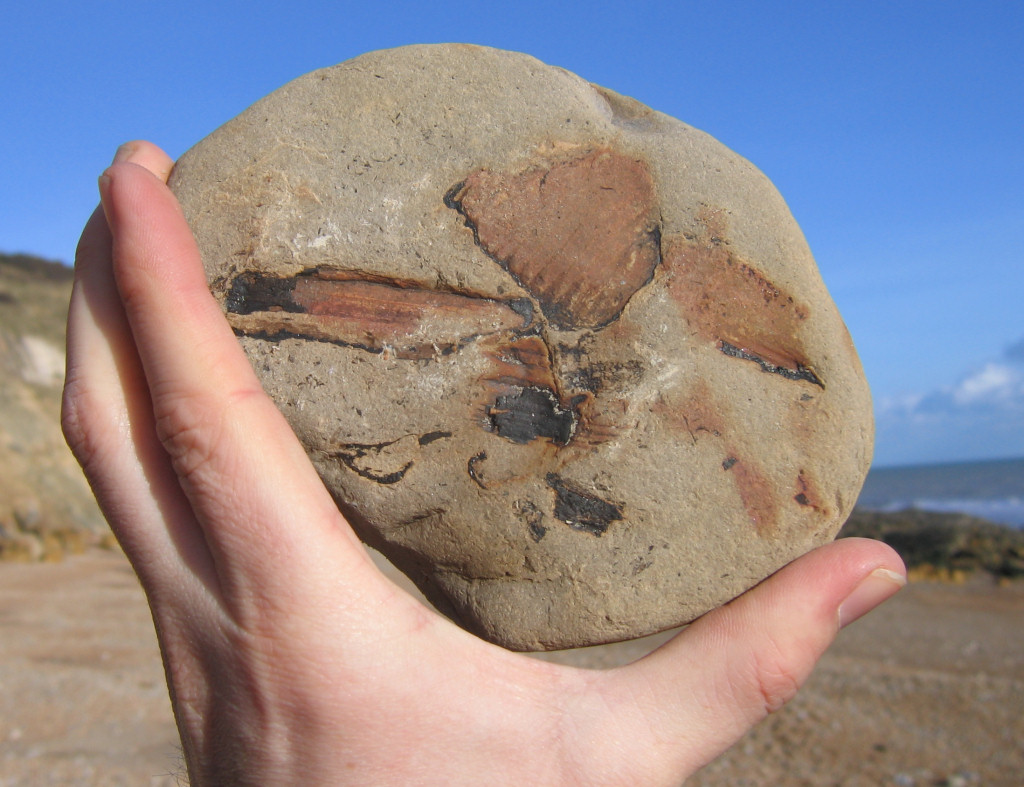
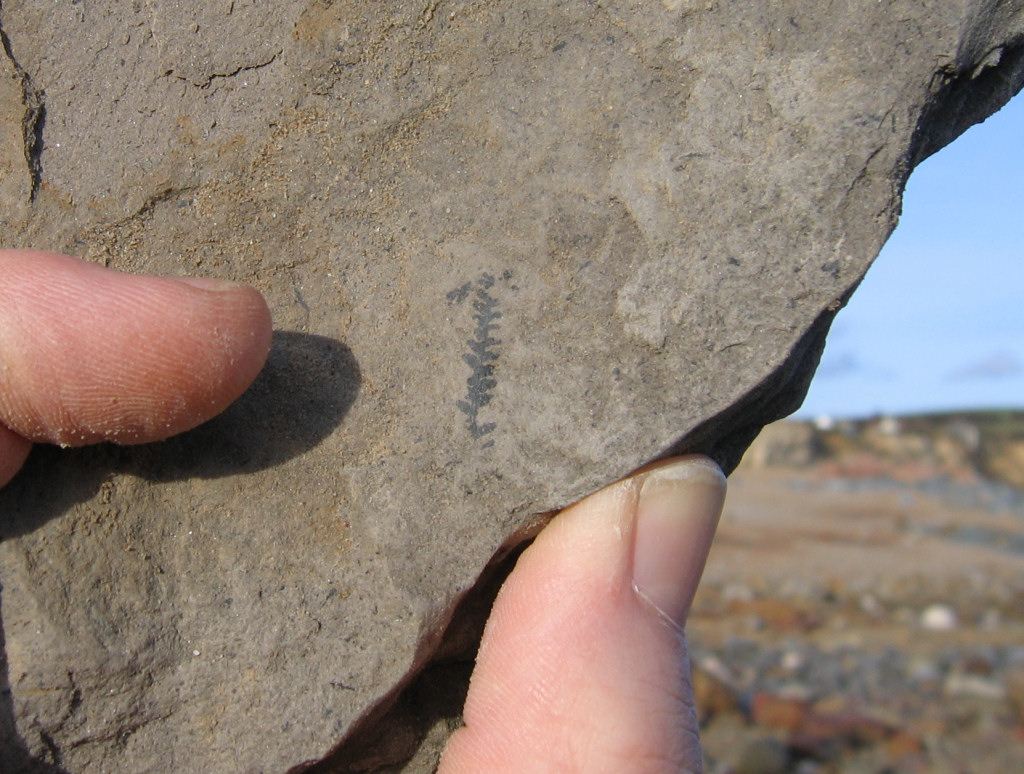
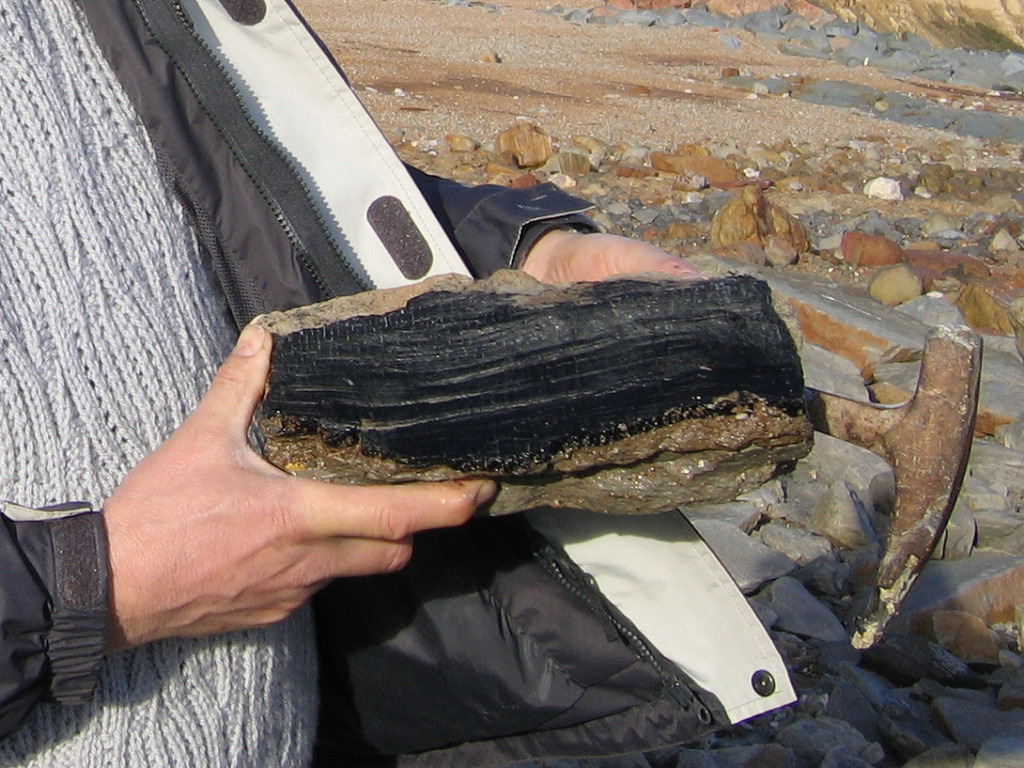
For much of the Berriasian and Valanginian stages the climate was sub-tropical with seasonal changes in temperature and rainfall. The mostly low-lying terrain was home to a rich plant flora, revealed by the abundance of fossilised plant material found throughout the succession. Conifers and related plants were the dominant tree and cycad-like plants were also present. Grasses did not exist during the Cretaceous, instead the ground was covered by the horsetail Equisetites.
Perhaps the most exciting aspect of the sandstone is the presence of dinosaur bones and footprints, including carnivorous (meat-eating) and herbivorous (plant-eating) species. These dinosaurs would have grazed and hunted respectively along the river and lake sides, leaving their footprints in the sediment.

Moving along the coast from Pett Level towards Fairlight Cove the geology becomes increasingly older, assisted by the presence of two reverse faults: Haddock’s fault (Fig. 2 and 3) and Fairlight fault (Fig. 4). These faults formed suddenly as energy was released from the pressure built up by Africa colliding with Europe – a process that created the Alpine mountain chain and uplifted south-east England into a large dome-shaped structure, known as the Wealden Anticline (see Hastings for more detail). As the uplifting took place the rock at Fairlight was compressed laterally forcing one side to slip upwards over the other.
At Haddock’s fault the cliffs on the south-west side have been thrust upwards, the lower section of the Ashdown Formation (Sandstone) is visible at beach level (Fig. 3). Over time erosion has removed the upper section of the Ashdown Formation. On the north-east side of the fault the majority of the Ashdown Formation is below beach level; the overlying Wadhurst Clay Formation is visible in the middle to upper sections of the cliff face.

Since the original Alpine uplifting the land on the immediate south-west side of Haddock’s fault has slipped backwards (in the direction of its natural position), resulting in a visible slip-plane across the exposed Wadhurst Clay (highlighted yellow). This should not be confused with the earlier large-scale movement which was in the opposite direction.
At the opposite end of Fairlight Cove a second reverse-fault (Fairlight Reverse Fault) can be seen (Fig. 4). Here the underlying Fairlight Clay (belonging to the Ashdown Formation) can be seen in the slumping cliffs and foreshore south-west of the fault line. These clays were formed by fine sediment transported by rivers and streams then deposited in deeper parts of the lake/lagoon. Some authors have attributed the finer sediments to periods to reflect periods of reduced rainfall during which erosion of the source rocks was less.

Where to look for fossils?
Fossils can be found throughout the rocks at Fairlight and Pett Level, although the volume of finds tends to be relatively low compared to neighbouring coastal stretches. It can take several visits to Fairlight, without expert guidance, before a sufficient number of fossils have been observed in order to build a picture of how this prehistoric environment may have looked.
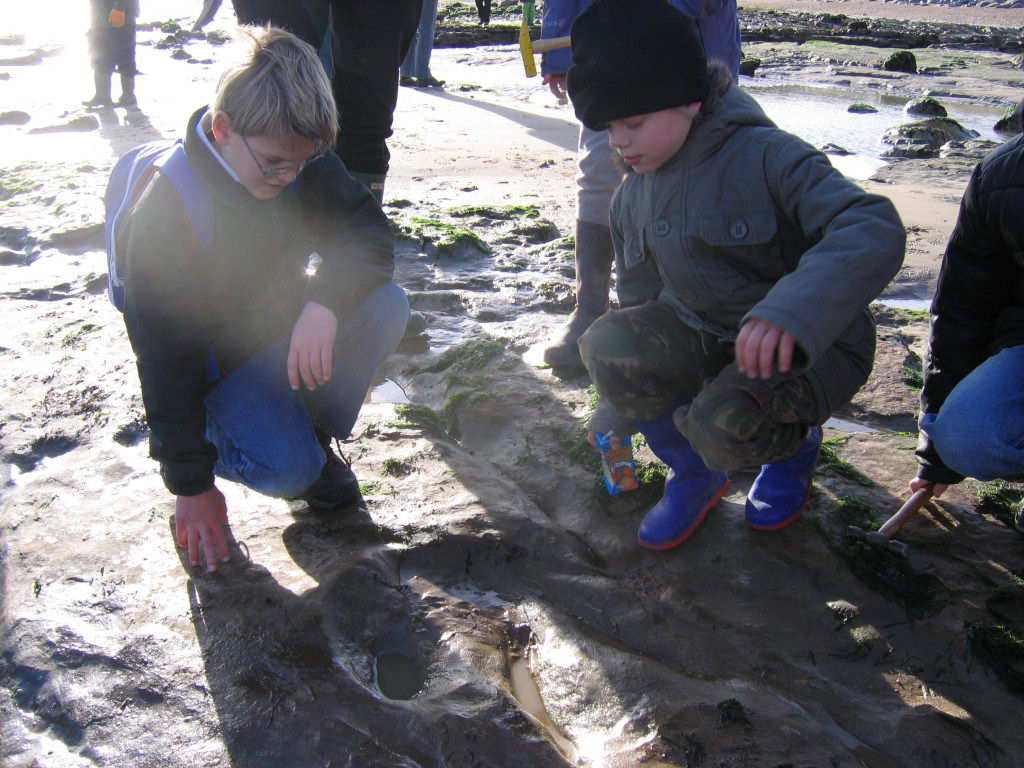
The best place to search is on the exposed foreshore and among the boulders and shingle. At low-tide, provided shingle isn’t covering its surface, the exposed Ashdown Sandstone can be viewed on the foreshore (see photo below). During a recent Discovering Fossils event a number of well preserved dinosaur footprints were located in situ at this location.
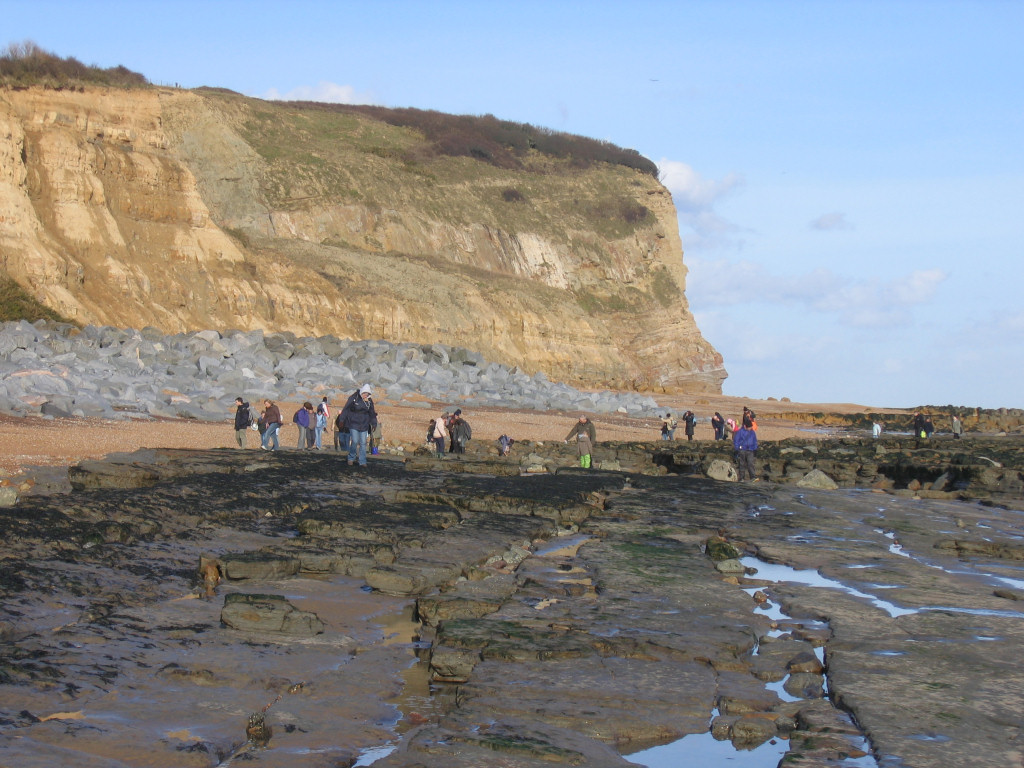
Occasionally dinosaur, crocodile and turtle bones can be found loose among the boulders and shingle, these bones tends to be dark brown, with a slightly pitted surface. The best technique to find bones is to walk very slowly, carefully scanning your eyes for suspect rocks; they’re not easily found, but not impossible to find either.
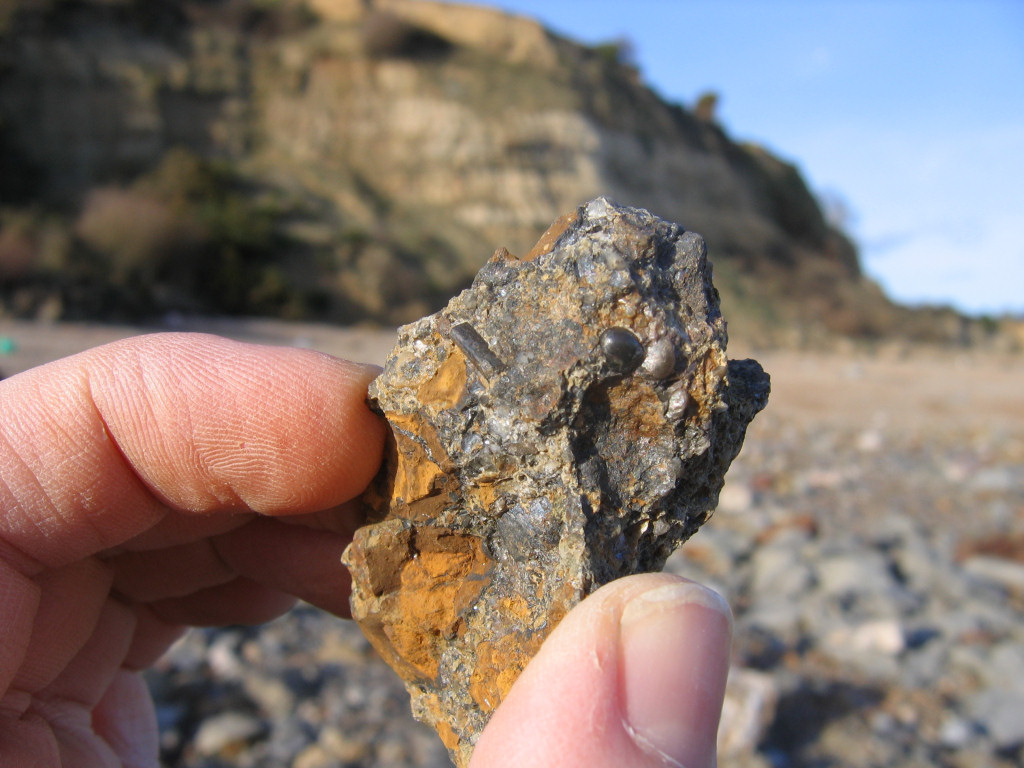
At Pett Level some of the fallen boulders, originating from the upper part of the cliff (Wadhurst Clay Formation), are comprised of a course conglomerate, known as the Cliff End Bone Bed. The photo below-left shows a split fragment of bone bed containing a circular tooth belonging to the fish Lepidotes; a small rectangular piece of unidentified bone can also be seen. Other finds include teeth belonging to the freshwater shark Hybodus and even small mammals.
As with all coastal locations, a fossil hunting trip is best timed to coincide with a falling or low-tide. For a relatively low one-off cost we recommend the use of Neptune Tides software, which provides future tidal information around the UK click here. Alternatively a free short range forecast covering the next 7 days is available on the BBC website click here.
What fossils might you find?
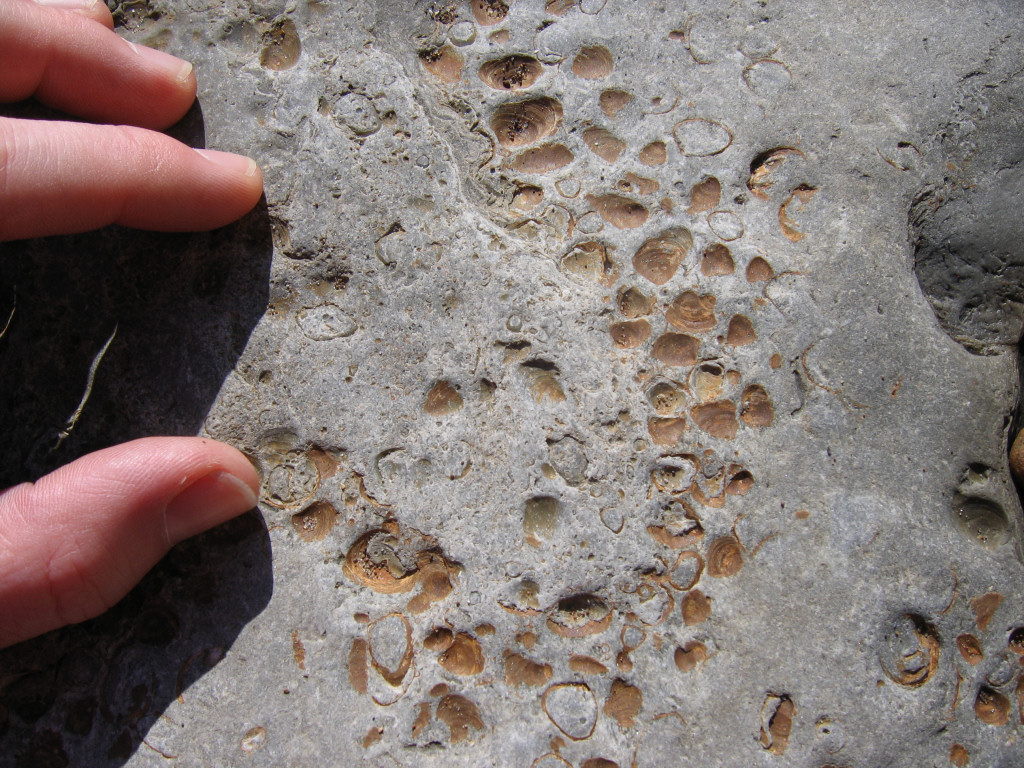
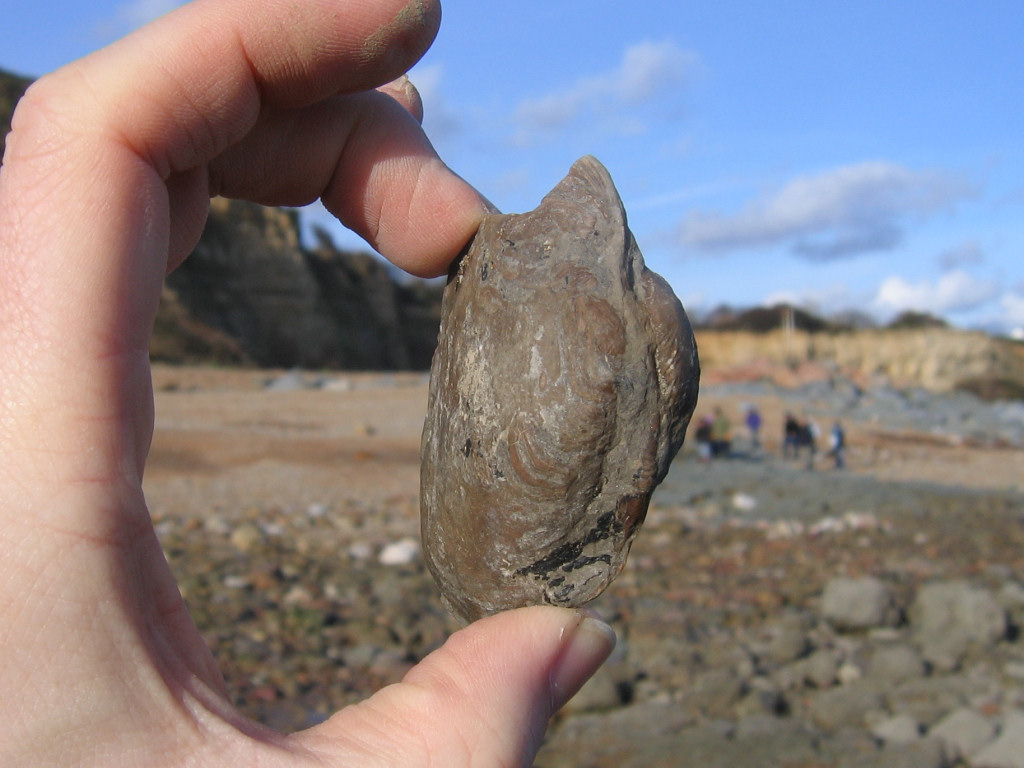
The most commonly found fossils at Fairlight and Pett Level are collections of the bivalve Neomiodon, which are visible on the surface of many foreshore boulders. Plant remains are also common, in particular roots belonging to horsetail plants. Although dinosaur remains are rare the most frequently found include teeth, jaws, vertebrae, ribs and limb bones of the large bipedal (two-legged) Iguanodon.
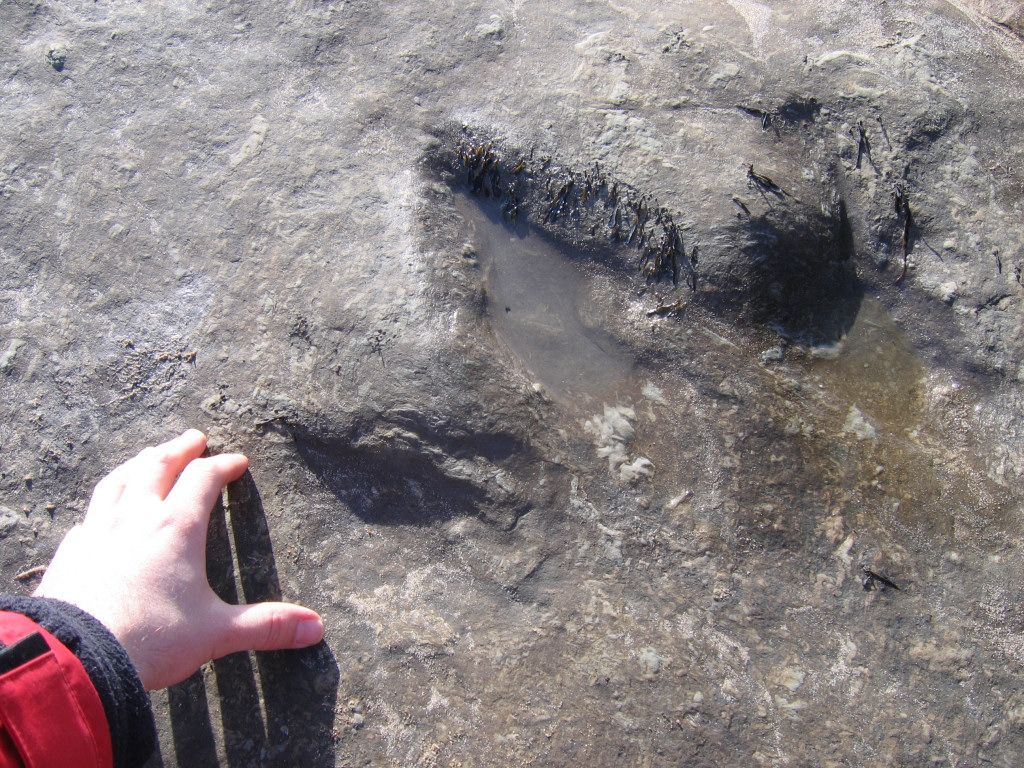
Please respect the footprints and do not damage or attempt to collect any part of them. We wish to remind visitors that these are rare and scientifically important, as well as protected.
References: www.english-nature.org.uk; Geology and Fossils of the Hastings area, Ken Brooks; Department of Palaeontology, Natural History Museum, Fairlight field trip notes, Oct ’03; Geological Conservation Review Series, Fossil Reptiles of Great Britain; A Dynamic Stratigraphy of the British Isles, R.Anderton and co; The Geology of Britain, P.Toghill; A Geologic Time Scale 2004, by F. Gradstein, J. Ogg and A. Smith.